The Thirty Years’ War was raging in Europe, fueling a near–cold-war divide between Protestant and Catholic powers. France, under Catholic monarchs like Louis XIII, was aggressively Counter-Reformationist, using the Jesuits as intellectual and spiritual shock troops to reclaim ground lost to Protestantism. Meanwhile, across the Atlantic, the New World was a chaotic frontier. French, English, and Dutch colonies raced for fur; beaver pelts were gold in Europe, along with timber, trade routes, and strategic outposts. Rumors of immense wealth drew all manner of settlers, soldiers, and dreamers. But this “new” world was already full of nations. Indigenous confederacies like the matriarchal-leaning Iroquois (including the Mohawk) were fierce warriors, portrayed in European accounts as “ruthless” for their expansionist Beaver Wars (1600s–1700s). They displaced or absorbed rivals through raids and alliances, practicing rituals that colonizers sensationalized as “witchcraft.”
Founded in 1540 by Ignatius of Loyola amid the Protestant Reformation, the Jesuits were the Catholic Church’s elite vanguard. They were highly educated, many fluent in multiple languages and trained in the sciences, and bound by vows of absolute obedience to the pope. To their critics, both Protestant and Catholic, they seemed radical, shadowy operators accused of political intrigue, moral hair-splitting (casuistry), and even fanaticism. In Protestant England, they were branded traitors for smuggling priests or plotting against the state. England was undergoing its own seismic shift. Henry VIII, frustrated by the Pope’s refusal to annul his marriage to Catherine of Aragon so he could marry Anne Boleyn and secure a male heir, broke from Rome. Through the Act of Supremacy, he declared himself Supreme Head of the Church of England. Anglicanism was born. No more papal authority. The king now ruled crown and creed. Monasteries were dissolved, treasures looted, Henry raked in an enormous fortune, and anyone clinging to Catholicism risked treason. But this was not what Martin Luther’s Reformation of 1517 had been about. Luther himself condemned Henry’s move as “adultery dressed as theology.” In 1530, he wrote, “The King of England has made a new faith to suit his lust.” Luther refused to endorse the divorce or the new church. And yet, when Elizabeth I later executed Jesuits like Edmund Campion in 1581, the Genevan and Dutch Reformed didn’t mourn. They too saw Jesuits as agents of the Antichrist. There was division among all aspects. Still, many English Catholics, known as recusants, quietly resisted: refusing oaths, hiding priests, and smuggling rosaries. To Henry and his successors, Edward VI, Mary I, and Elizabeth I, such defiance was treason.
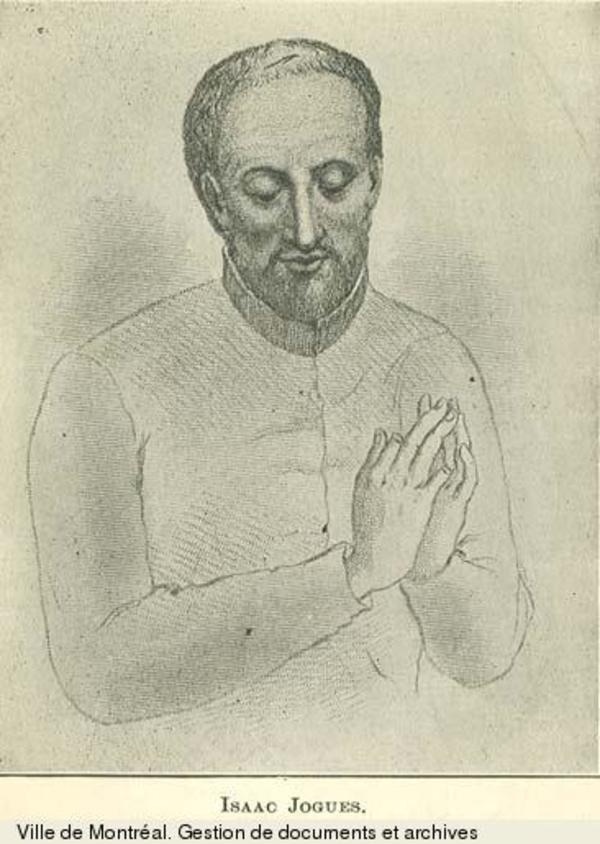
Into this age of tension and empire was born Isaac Jogues in 1607, in Orléans, France. At seventeen, he entered the Society of Jesus. Ordained in early 1636, he was immediately sent to New France. The Jesuits themselves, specifically the order’s provincial superiors in France, sent him there as part of their broader effort to evangelize Indigenous peoples in the Americas, aligning with the French colonial push into the region. Jogues worked among the Huron (Wendat) and Algonquin, allies of the French and rivals of the Iroquois Confederacy. In August 1642, Jogues and 22 Huron allies, along with 3 other Frenchmen (including René Goupil), paddled forty canoes of trade goods from Quebec to the Huron mission at Sainte-Marie. About seventy Mohawk warriors, allied with the Dutch, ambushed them during a raid. The Mohawk immediately recognized the “Blackrobe”—the Jesuit cassock. They had heard Dutch rumors: “The French priests bring smallpox and curses.” Dutch pastor Johannes Megapolensis later wrote in 1644, “The Mohawk say the French priests bring smallpox in their books and crosses.” Whether the Dutch started these rumors or not, they certainly used them to warn the Mohawk away from French alliances. To the Mohawk, foreign priests performing unseen rituals looked like sorcery. Jesuits arrived; villages got sick; Jesuits survived. To them, the link was “obvious”. Jogues and his companions were marched for three days, hands tied, without food. Jogues carried a wounded Huron boy on his shoulders. The Mohawk mocked him: “Blackrobe, your god walks slow.” At Ossernenon ( Auriesville, NY), over 300 Mohawk men, women, and children beat them. Jogues’ shoulder was dislocated, his fingernails torn out, fingers gnawed, and face slashed. Burning coals seared his belly. His beard and hair were ripped out by hand. They chewed off his thumbs and index fingers so he couldn’t make the sign of the cross, neutralizing his “magic.” The mutilation marked him as a slave, too crippled to wield weapons. And yet, even in slavery, Jogues baptized over seventy souls in secret. He carried a splinter of the True Cross sewn into his cassock. One young Mohawk girl later remembered as an ancestor of Kateri Tekakwitha recalled, “The Blackrobe prayed with us in the dark. He said our dreams could meet Jesus.” She went on to do much wondrous work for the Lord. A smallpox epidemic soon swept Ossernenon, killing one-third of the village. The Mohawk blamed Jogues’ crucifix case. They sentenced him to death by fire on August 15, 1643.
Dutch traders, including Arent van Curler and Pastor Megapolensis, intervened. They offered 200 guilders’ worth of wampum, kettles, and cloth, persuading the Mohawk to delay. Jogues was hidden in a Dutch attic for six weeks, emaciated and mutilated. Megapolensis wrote, “We fed the papist in secret. His hands are stumps, but his eyes burn like coals. He forgave the Indians who ate his fingers.” The Mohawk moved Jogues to a fishing camp 10 miles from the village (to avoid pox). The Dutch, sensing an opening, whispered a chilling warning to the Mohawk: “Kill the Blackrobe, and the pox will return stronger, deadlier.” The warning bought time, and at night a Dutch trader slipped into the camp and slipped a small knife into Jogues’ bound hands. That night, Jogues cuts the rope around his ankle and slips out into the dark.
He runs toward the river. He finds a barrel by the docks and hides inside. The Dutch loaded their ship, the St. Peter, bound for Manhattan, and he sailed down. Jogues curls up inside a crate, half-dead, whispering psalms as the ship sails down the Hudson. I often look at that same river and imagine the scene. He arrived in France in November 1643. When he stepped ashore in Brittany, he kissed the ground. He then met with his mother, and Pope Urban VIII granted him special permission to celebrate Mass despite his mutilation. Queen Anne of Austria, regent of France, kissed his mangled hands. He then wrote, “If I had a thousand lives, I would give them all for these people. They tore my body, but they could not touch my soul. I go back to France only to return to die among them.” He did return.
In 1646, Jogues returned to negotiate peace and plant a mission among the Mohawk. He traveled with three Huron guides and Jean de Lalande, a lay brother. At first, it seemed promising. The Mohawk Bear Clan welcomed him. The Wolf Clan did not. He baptized twelve souls, taught Latin hymns to children, and planted a cross in Ossernenon. But when a chest he had left locked was opened, revealing a carved crucifix, the Wolf Clan panicked. They believed it housed the spirit that brought smallpox. On October 18th, 1646, Jogues is invited to a feast in the Wolf Clan’s longhouse. He goes willingly. A Wolf warrior strikes first. A tomahawk flashes from behind in an unfair ambush. Jogues falls. Jean de Lalande, his young lay companion, sees the body and runs to embrace it. The same tomahawk swings again; he is beheaded. Their heads are placed on poles. The bodies were thrown into the Mohawk River. The Bear Clan, horrified, hide Jogues’ cassock as a relic. The French, furious, declare the peace treaty void. War ensues. The next morning, news reaches Quebec. The French governor hears it and declares war.
What makes Isaac Jogues’ story almost incomprehensible to a modern mind is his decision to go back. After enduring unimaginable torture, most of us would have called it the end. Most people, if they could even understand the horrors he endured, would think he was a fool to go back. And in human terms, maybe he was. In any rational calculation, in the currency of self-preservation, staying alive would have been the wisest, safest choice. Yet Jogues did not calculate with human currency. He measured the stakes by eternity. He knew the gospel he carried was not meant for a select few or for convenience. If it could save a soul, change a heart, or restore a life, then no earthly suffering, no risk of torture, and no threat of death could outweigh the value of that mission. If all die anyway, if every human scheme crumbles to dust, why not invest fully in what lasts forever? Why cling to safety when souls, perhaps even your own, hung in the balance? To endure once is remarkable; to endure knowing what awaits, to walk back into the danger voluntarily, and to trust in God’s providence and grace above your own instinct for life that is heroic in the truest sense. Jogues’ return was not folly but faith manifest. His courage became a conduit for the gospel to flow into Mohawk communities, into the conscience of the world, and into the pages of history that would inspire centuries. Every life touched, every soul glimpsing the love of Christ because he went back, is a ripple that echoes beyond empires, beyond wars, beyond time itself. What the world calls foolish, God calls faithful. What seems meaningless in the temporal, like the suffering, the torture, and the potential death, becomes the vessel through which eternal truth is delivered. Jogues’ return was a choice that defies human logic but perfectly aligns with God’s eternal plan. It reminds us that the measure of our actions is not how safe, how convenient, or how efficient they appear in this world, but how they participate in the enduring work of God’s kingdom. In the end, the Roman armies, the Mohawk warriors, the colonial disputes, the diseases, and the politics are all temporary. Jogues’ courage, his willingness to embrace suffering for the sake of the gospel, and his voluntary return to danger, matters forever. Every soul that encountered the love of God because of him, every missionary inspired by his witness, every reader centuries later contemplating his faith all of it flows from that single, beautiful choice to go back. Do not misunderstand his courage. Jogues was not reckless, nor does the gospel call us to seek martyrdom as an end in itself. Do not go searching for death. Seek instead to be a true witness of the faith, to live and act in fidelity to Christ, and to love and serve boldly, no matter the cost. If suffering comes, endure it with grace; if danger appears, face it with wisdom. True witness is measured not by how much pain we can bear, but by how fully our lives point to the truth and love of God. Historically, Isaac Jogues stands as a living example of Christlike endurance; his journal records a kind of suffering that mirrors the early church: sacrificial, ordered, and fully surrendered to God’s will. He wrote not with bitterness, but with praise, even after having his fingers mutilated and enduring captivity. Jogues saw every hardship as a chance to serve and glorify Christ, not to prove his toughness or earn status. Yet there’s a very different kind of suffering that’s taken root in modern thinking, the mindset that treats pain like a badge of honor and self-denial like a moral system. Was he suicidal? No. Was he obsessed with dying? No. Was he obsessed with saving souls even at gunpoint? Yes. He never used violence. Only water, words, and presence. He carried no gun or sword, just a cross and a peace treaty. Jogues even said to a Mohawk child, “I will not make you Christian. But if you die, I will ask Jesus to take you.”
Thinking about this today, we often confuse grind for godliness. After reflecting on Jogues’ example, we have to ask ourselves: when is suffering truly redemptive, and when is it just self-inflicted performance dressed up as virtue? There is a mindset that glorifies suffering for its own sake, that treats self-denial like a moral scoreboard. “Push through everything. Reject comfort. Grind 24/7. If you’re not exhausted, you’re weak.” On the surface, it’s tempting. It can teach toughness, resilience, and discipline. There’s value in challenging yourself, in learning to endure hardships. That grit can build character, help you overcome real obstacles, and show what you’re capable of. But here’s the flip side: when endurance becomes the goal itself, it starts to crack. Life isn’t meant to be a constant contest of who can suffer the most. That “always push, no excuses” mentality assumes you’re alone, that you carry all responsibility for your success or failure. Nobody thrives like that. Humans need people, mentors, friends, family, those who challenge us, guide us, and sometimes annoy us. Push too hard in isolation, and you break yourself chasing a standard that isn’t yours to own. You start confusing grinding for godliness and endurance for holiness. Without that guidance, without accountability, you can work incredibly hard, pour yourself into endless effort, and still be going the wrong way. Hard work doesn’t automatically lead to truth or meaning; it only magnifies the consequences. The only true guide in life is the Holy Spirit and the Church, which is a body of people with the Holy Spirit in its most true definition. The danger is subtle. You go hard, you reject comfort, and you push past fatigue, but at what cost? Relationships, presence, joy, gratitude, inner peace. You can forget the very reason you’re grinding in the first place. The obsession with proving toughness creates a kind of unhealthy competition: who can endure the most pain, who can work the longest, and who can outlast everyone else? But life isn’t about flexing endurance; it’s about using your strength for what actually matters. Be tough in pursuit of your goal, don’t make the goal being tough. This mindset also ignores the diversity of human purpose. Not everyone wants to chase the same milestones, lift the same weight, or hit the same grind schedule. Some are building families, creating art, or healing from a rough life. Endurance, discipline, and resilience are tools. They’re necessary. They shape us and prepare us for trials. But suffering should never be the goal itself. Like Jogues, suffering can be redemptive when it’s tied to something higher, something meaningful. Otherwise, it’s a trap, a cycle of exhaustion and missed life. Real strength is knowing when to push and when to pause, appreciate, and love. Discipline is good, but the whole point is to walk humbly with the spirit. This story’s outcome may seems conflicted, on one hand, it’s presented as noble or redemptive, but on the other, Jogue’s actions led to death and sparked a war. Redemption isn’t simply about conflict or loss; it’s about transformation and peace. Yet, when we look at the disciples and the apostles, we see a similar pattern of suffering and consequence. I’m reminded of Scorsese’s film “Silence,” which portrays the dark side of martyrdom, yet what it misses is that, in Christ, martyrdom isn’t despair but eternity. If we truly believe that, we have to consider the immense weight of what it means. I’m not saying to go and sacrifice yourself recklessly; I’m saying God wills it all! Even in ordinary life, when we understand the extreme example, the simple becomes clearer. Christianity does honor martyrdom, but it also values discernment. We must remember: there is chaos, but God is not the author of chaos. He entered it and conquered it.
Love can cost everything, and yet Christ is worth the cost, because He is everything. I know it’s strange for a Protestant to write this article on a Catholic Jesuit priest from four centuries ago. But truth is truth, and courage is courage. Forgiveness isn’t foolishness. It’s victory. Isaac Jogues did not live for France or Rome, but for Jesus. And Jesus is greater than any denomination, any banner, or any empire that claims His name. Not a bad ending when Christ is involved, for though all die, Jogues entered eternity.
Standing here, looking at the same stretch of the Hudson River that Isaac Jogues sailed down 382 years ago, I feel awe and humility. To trace the path of a man who endured unimaginable suffering, who crawled and prayed and forgave, brings history to life in a way no book ever could. But even more than the weight of history, I am struck by the power of God. Four centuries later, empires rise and fall, and yet God’s goodness remains unshaken. He is bigger than the politics, bigger than the wars, bigger than the suffering of any one man, and yet He works in hearts, in souls, in ways that echo through centuries. A reminder that human suffering or chaos or strife is never wasted when placed in His hands, and that His goodness is always, always more powerful than anything we can endure or imagine.
Please join a church family today!
𝕯𝕰𝖀𝕾 𝖁𝖀𝕷𝕿 . 𝕹𝖔 𝖌𝖚𝖎𝖑𝖙 𝖎𝖓 𝖑𝖎𝖋𝖊, 𝖓𝖔 𝖋𝖊𝖆𝖗 𝖔𝖋 𝖉𝖊𝖆𝖙𝖍, 𝖙𝖍𝖎𝖘 𝖎𝖘 𝖙𝖍𝖊 𝖕𝖔𝖜𝖊𝖗 𝖎𝖓 𝕮𝖍𝖗𝖎𝖘𝖙 𝖎𝖓 𝖒𝖊 𝖋𝖗𝖔𝖒 𝖑𝖎𝖋𝖊’𝖘 𝖋𝖎𝖗𝖘𝖙 𝖈𝖗𝖞 𝖙𝖔 𝖋𝖎𝖓𝖆𝖑 𝖇𝖗𝖊𝖆𝖙𝖍. 𝕵𝖊𝖘𝖚𝖘 𝖈𝖔𝖒𝖒𝖆𝖓𝖉𝖘 𝖒𝖞 𝖉𝖊𝖘𝖙𝖎𝖓𝖞!!!!
𝕭𝕰𝕹 𝕬𝕹𝕿𝕳𝕺𝕹𝖄 𝕾𝕴𝕸𝕺𝕹
Writing as 𝖂𝕴𝕷𝕷 𝕱𝕺𝕽𝕲𝕰
𝕻𝕴𝕷𝕲𝕽𝕴𝕄 𝕻𝕺𝕹𝕯𝕰𝕽𝕴𝕹𝕲𝕾 𝕸𝕴𝕹𝕴𝕾𝕿𝕽𝖄
Works Cited
Bancroft, George. History of the United States. Vol. 3, Little, Brown and Company, 1876.
Beza, Theodore. Correspondence. Edited by Hippolyte Aubert, Librairie Fischbacher, 1890.
Bullinger, Heinrich. Letters to the English Exiles. Zurich, 1550s. In The Decades of Henry Bullinger, edited by Thomas Harding, Parker Society, 1849–1852.
Calvin, John. Institutes of the Christian Religion. Translated by Henry Beveridge, Calvin Translation Society, 1845.
Campion, Edmund. Edmundi Campiani Decem Rationes et Alia Opuscula. Antwerp, 1631.
—. Historie of Ireland. In Holinshed’s Chronicles, edited by Raphael Holinshed, vol. 6, Henry Denham, 1587.
Charlevoix, Pierre François Xavier de. Histoire et Description Générale de la Nouvelle France. Vol. 2, Paris, 1744.
Dallmann, William. “Henry the Eighth’s Divorce and Luther.” Concordia Theological Monthly, vol. 18, no. 1, 1947, pp. 1–15.
Dionne, Narcisse Eutrope. “Le Père Jogues et les Hollandais.” Bulletin des Recherches Historiques, vol. 10, 1904, pp. 60–64.
Ecclesiastical Records of the State of New York. Vol. 1, New York State, 1891.
Forest, Abbé. Life of Isaac Jogues. Manuscript, St. Mary’s College, Montreal, n.d.
Greer, Allan, editor. The Jesuit Relations: Natives and Missionaries in Seventeenth-Century North America. 2nd ed., Bedford/St. Martin’s, 2000.
Harris, Dean. History of the Early Missions in Western Canada. Toronto, 1893.
Lafitau, Joseph François. Moeurs des Sauvages Américains. Vol. 2, Paris, 1724.
Lalemant, Jérôme. “How Father Isaac Jogues Was Taken by the Iroquois, and What He Suffered on His First Entrance into Their Country.” The Jesuit Relations and Allied Documents, edited by Reuben Gold Thwaites, vol. 23, Burrows Brothers, 1898, pp. 1–133.
Luther, Martin. Commentary on Deuteronomy. Wittenberg, 1530.
—. To the Christian Nobility of the German Nation. Wittenberg, 1520.
Martin, Félix. Le R.P. Isaac Jogues de la Compagnie de Jésus, Premier Apôtre des Iroquois. Paris, 1873.
McEntegart, Rory. Henry VIII, the League of Schmalkalden, and the English Reformation. Boydell Press, 2002.
Megapolensis, Johannes. “A Short Account of the Mohawk Indians, Their Country, Language, Figure, Costume, Religion, and Government.” 1644. In Narratives of New Netherland 1609–1664, edited by J. Franklin Jameson, Barnes & Noble, 1909.
Memorial of the Death of Isaac Jogues and Others. Manuscript, Université Laval, Quebec, n.d.
Parkman, Francis. The Jesuits in North America in the Seventeenth Century. Little, Brown and Company, 1867. Project Gutenberg, www.gutenberg.org/files/6933/6933-h/6933-h.htm. Accessed 12 Nov. 2025.
Perkins, William. A Golden Chaine. John Legat, 1600.
Petiot, Henri [Daniel-Rops]. Les Aventuriers de Dieu. Paris, 1951.
Ragueneau, Paul. “Mémoires Touchant la Mort et les Vertus des Pères Isaac Jogues.” Archives de la Société de Jésus de Montréal, repr. in Rapport de l’Archiviste de la Province de Québec, 1924–1925, pp. 3–41.
Rochemonteix, Camille de. Les Jésuites et la Nouvelle-France au XVIIe Siècle. Vols. 1–2, Letouzey et Ané, 1895.
Shea, John Gilmary. Life and Times of the Most Rev. John Carroll. New York, 1857.
—. Life of Father Jogues. New York, 1885.
Simpson, Richard. Edmund Campion, Jesuit Protomartyr of England. London, 1866.
Talbot, Francis Xavier. Saint Among Savages: The Life of Saint Isaac Jogues. Harper & Brothers, 1935.
Thwaites, Reuben Gold, editor. The Jesuit Relations and Allied Documents: Travels and Explorations of the Jesuit Missionaries in New France, 1610–1791. 73 vols., Burrows Brothers, 1896–1901. Internet Archive, archive.org/details/jesuitrelationsa10thwa. Accessed 12 Nov. 2025.
—. The Jesuit Relations and Allied Documents. Vol. 31, Burrows Brothers, 1899. Creighton University, moses.creighton.edu/kripke/jesuitrelations/relations_31.html. Accessed 12 Nov. 2025.
Vann, Joseph, O.F.M., editor. Lives of Saints with Excerpts from Their Writings. John J. Crawley & Co., 1954.
Van Curler, Arent. “Letter to Kiliaen van Rensselaer.” 16 June 1643. New York State Museum, partially burned in 1911 fire.
Ware, James. De Hibernia et Antiquitatibus Ejus. Dublin, 1633.
Wikipedia Contributors. “Isaac Jogues.” Wikipedia, The Free Encyclopedia, Wikimedia Foundation, 18 Oct. 2025, en.wikipedia.org/wiki/Isaac_Jogues. Accessed 12 Nov. 2025.
—. “The Jesuit Relations.” Wikipedia, The Free Encyclopedia, Wikimedia Foundation, 1 Nov. 2025, en.wikipedia.org/wiki/The_Jesuit_Relations. Accessed 12 Nov. 2025.
 Pilgrims Ponder
6 responses to “Isaac Jogues: The Missionary Who Walked Back Into the Fire”
Well, I’m sitting here waiting for a friend having eye surgery, almost too overwhelmed to breath after reading another one of your powerful, transforming, eye-opening essays. I highlighted so many sentences and phrases, taking screen shots as I read, I’ll have to open a new folder just for them. I want to hold on to them all, not lose a word. Here’s the last one I cc’d: “Discipline is good, but the whole point is to walk humbly with the spirit.”
Forever grateful,
Deb
LikeLiked by 1 person
Deb, thank you for taking the time to read it, especially in a moment like that. I’m grateful the piece spoke to you. your words are very generous. I never expect anyone to sit with these essays that closely, so it means a great deal. If any line in there helps someone walk with the Spirit a little more steadily, then the work was worth it. Praying all goes well with your friend’s surgery.
Always a blessing to hear from you !
LikeLiked by 1 person
Well, thanks so much for your prayers! She let me know last night that the vision in the surgical eye was clear!
It’s always a blessing to read your work—thank you—and hear from you too!
LikeLiked by 1 person
Amen ! Thank you for the praise report. God Bless! Hope you had a good thanksgiving and have a Merry Christmas!
LikeLiked by 1 person
You too! By the way…can I ask your name?
LikeLiked by 1 person
Sure , my real name is Ben A Simon but I write by Will Forge.
LikeLiked by 1 person