Little towns, tucked away far from the main roads. You’ve seen them, but have you thought about them? (Shoutout twilight zone) New Paltz is one of these towns. And yet, it is becoming more and more known by more and more people. It sits just off the highway, close enough to the flow of New York City and Albany to be reachable, but far enough to feel separate. People arrive here intentionally. They come because they heard about it. Because someone told them it was different. Because they needed space, many different reasons, and many different people. New Paltz is a town of every mind. There is a small college here, and students come for a short time. They arrive with ideas, ambitions, causes, and confusion. They live intensely. Then they return to the greater place they decided to leave for a moment.
Artists. Contractors. Professors. Evangelicals. Mystics. Skeptics. Entrepreneurs. Activists. Retirees. People who want to escape the system. People who want to redesign it. Every mind is here. Conservative and progressive. Traditional and experimental. The spiritual and the materialist. All compressed into one small valley beneath the Shawangunks. The families who were here for decades slowly thin out. Property shifts hands. Farms become rentals. Old houses become investments. What was once inherited becomes listed as the refugees of transactional war move in. Like its neighboring towns, its history is deep. The history here is deeper than it seems. Every piece of everything is connected. The land deeds trace back to colonial patents. Those patents trace back to royal authority. Royal authority traces back to European crowns. Decisions made by monarchs across the Atlantic shaped who owned what in this valley. Who had rights and who didn’t. Who could worship freely. Who had to flee. There were those here before the patents. But they had their own boundaries. Their own systems. And many carried the same heart issue. The same struggle over power, land, and control. Realistically, there are those who impacted where I stand more than were impacted by it.
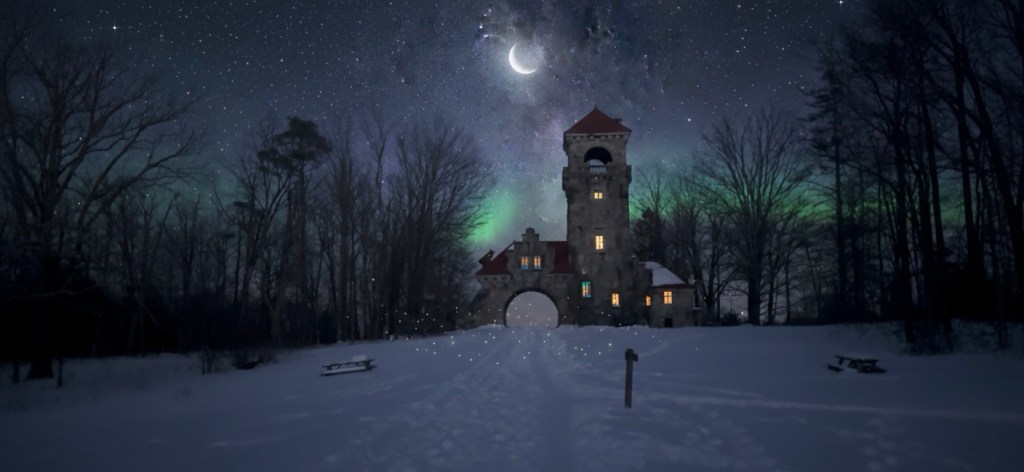
It’s still below forty degrees, but for the first time in weeks it finally feels warm. The sun hits your face, and it matters. After days of low single digits, this is enough. It doesn’t take much to be motivated to walk. When motivation is tied with excitement and other things, preparation tends to shrink. You want to move, to be out, to feel it. So I decided to take a big walk. Maybe I should have brought water. Maybe a coat instead of just a sweatshirt. But I was willing. Finally willing to be out there. I began at the Testimonial Gateway. Just outside the city, past the farmland, at the base of the rocky Shawangunk cliffs, there sits a mystical, medieval, castle-like building. It rises quietly on the hill, half-hidden by trees and shadow. It’s on the carriage road that leads to Mohonk Mountain House, a hidden world perched above the valley. I decided to walk the whole way to the Mountain House. A constant uphill pilgrimage. My sneakers weren’t made for this; I was underprepared for deep snow, but I went anyway. The trail changed constantly some parts barely wide enough for my feet, others more open, but always snow deep enough to make every step matter. I had to step into existing footprints, careful not to fill my shoes and freeze my feet. I wanted to run, and I did. Not as careful as I probably should have been. I told myself the warmth of my feet from running would balance the cold. The journey would be about ten miles. Before starting, I sat for a moment on the stone bench carved from the great arch of the Gateway. The rock was too cold to sit on long. I sat on the bench and thought about those who came before me. Many greats have passed through that very archway. Presidents who built canals, who signed treaties, and who won Nobel Peace Prizes. Reformers, revolutionaries, naturalists, abolitionists. Writers, actors, and thinkers of every kind. Great minds who walked the same land I am about to. I began the climb down a long, narrow path, leaving the towns, farms, and the castle below behind. The first stretch took me past a long row of straight trees lining big fields where cows roamed lazily. A little bridge carries you over a quiet road, rarely busy, a crossing made for the sake of a local view people still value. Beyond the fields, the rocks of the Shawangunks rise sharply, bold and beautiful against the great blue sky. In the distance, I can see a small lighthouse perched on a mountain called Sky Top. I know that just beyond it lies the destination I will soon be walking back from. As I climbed the rough track, I let instrumental music fill the air around me; songs like La Tierche: Estampie Roial and others played softly. I tried to run when my lungs allowed it, but even in motion, the view was constantly breathtaking. I couldn’t help thinking about those who had walked this trail before me, their time, their thoughts, and their steps, but soon those thoughts would fade, leaving space to observe for myself. To learn from my own steps and not only others.
Though underprepared and always uphill, my feet didn’t stop until I came across a pack of deer. They were remarkably unfrightened, even this deep in the woods, where no other footprints marred the trail. You’d think they’d have little experience with humans, and yet they paid me no mind. One lay in the snow, chewing on a snack, utterly unconcerned with the audience I happened to be. The rocks themselves were strange and captivating. You could see evidence of the plug-and-feather method in deep, rusty lines etched into the stone. Quartz and harder rock protruded sharply. Some of it seemed to leak a black, ink-like ooze. Farther ahead, I glimpsed another pack of deer. The second pack of deer was near a well. The well had a small wooden, manger-like hut built around it, with a plaque warning visitors to drink at their own risk. I approached carefully over the ice. Looking up into the wooden frame, I saw ice running along its edges, thick and glistening, with a small pipe lodged in the middle. Water splashed against the encased ice; I broke away the ice until the flow ran freely into the air. Ducking down, I took a long sip of the ice-cold, refreshing water, letting it wash over me, sharp and invigorating, a reward for the climb. Once the path finally leveled out, I could see Lake Mohonk, a beautiful lake perched atop the mountain, filled to the brim with lake trout and rainbow trout, big enough to be every fisherman’s dream. Frozen now, it was barely touched. Nobody ice fishes here; the surface lay smooth. Approaching the Mohonk Mountain House, an eccentric manor pulled from a 19th-century novel. Emerging from the winding, forested carriage roads of the Shawangunk Ridge, the building reveals itself as a massive, eighth-of-a-mile-long stone and wood fortress, anchored directly into the quartz cliffs above the deep blue glacial lake. Queen Anne Victorian wood sections with ornate gingerbread trim, Edwardian wings of hand-cut local stone, and Swiss Chalet-style parlors extending on giant trusses over the water. Every angle has something to catch your eye. As I reached the entrance to the trail on the Mountain House side, a couple from the city staying here for a Valentine getaway stopped me to ask for a photo in front of the fortress. They mentioned how cold I must be. Little do they know how far I’ve come.
I entered Mohonk Mountain House. As I approached the door, I began to see more and more people. Some were taking photos out on the back porch. Others were putting on snowshoes, getting ready for their own journeys. When I stepped inside, the brightness from the snow reflecting off the lake and cliffs clashed with the dim lighting of the interior. I was blind for a considerable amount of time. Luckily, I had worked in this place before. It was familiar enough that I could move through it with barely any sight. The room was overly warm. The thermostat read 79 degrees. A few people sat silently near the wood-burning fireplaces. I moved into the larger room where tea was offered. I poured myself a hot cup, then took another cup and filled it with cold water. I sat there for a moment, drinking both, letting my body reset. Out the window, the great Catskills stretched across the horizon. Today you could see uniquely far. I could see well past Slide Mountain. Quite the view. I thought about how used to this I became when I worked in the dining room every day. Back then it felt different. Back then it was being yelled at and rushed at 6 a.m., while my friends were out enjoying life without me. Today, it’s just a good view. And it makes me think about meaning. So far in this reflection, I’ve talked a lot about what things mean. But why does meaning even matter? But it does. For the sake of Christ, it does.
I then walked the old halls and looked at the art and portraits on the walls. The halls feel like a true museum. I saw the different people who passed through here, people like Theodore Roosevelt, Rutherford B. Hayes, William Howard Taft, Frederick Douglass, Mark Twain, Thomas Edison, and many more. This place was more than a resort. Mohonk Mountain House was a moral-intellectual hub of the late 19th and early 20th centuries. The Mohonk conferences took place here, where Albert K. Smiley, founder of Mohonk, would host invite-only gatherings that heavily influenced government policy, particularly on Native American assimilation policy and progressive reform. It’s interesting how this pattern hasn’t really changed. Many who criticize modern versions of elite policy circles often praise the past versions just as much, sometimes more, without realizing it. The Gilded Age and Industrial Revolution were high-impact times for this small area. In 1897, The New York Times wrote about nearby Binnewater in an article titled “Strange Ulster County Colony” and described the people there in some of the worst possible ways, openly dehumanizing them. Around that same time, studies like the Juke family study were happening in Ulster County, where people tried to explain crime and poverty purely through genetics. The wealthy of that time often held massive amounts of unearned wealth, and with that came power. People began fleeing industrial life and visiting upstate areas, but when they saw poverty, they asked, “What’s wrong with these people?” and often gave the wrong answer. If all we are is matter, then maybe that thinking makes sense. What autonomy would there be? But we are more than machines. We are image carriers of the Lord. There is meaning. And you don’t have to commit crime. This is not a caste system. You decide. Yet the Lord will carry you where you must be. You may flee from Nineveh. But sometimes a fish still brings you there. And if you still grumble, that doesn’t mean less liberation for Nineveh.
It just means more of a cage around you.
I eventually decided to begin the descent so I could make it back before dark. Twilight settled in as I walked down the mountain. This time it was more rush than reflection, but it was still good. I was listening to the Twilight Zone radio stories and letting my imagination follow along with them, letting the mountain and the stories mix together. Before I really realized it, I was back where I started. It was a good pilgrimage. There is more that comes from more effort. But the only reason there is such a thing as more of a good thing is because of God. Without Him, justice wouldn’t exist. History wouldn’t exist. Meaning wouldn’t matter. Thinking would be pointless. Goodness would be subjective; this may sound easier and smarter. But it isn’t right. If goodness is only opinion, then it isn’t goodness; it’s just preference with better marketing. I’m tired of eggheadness. The endless theorizing that never helps a single real person. Keep making systems. Keep making arguments. Keep making perfect frameworks. Everyone has a plan until they get punched in the face. Every ideology has eggheads. Every movement has people who can explain everything and fix nothing. At the end of the day, it’s about helping people. These are someone’s children. That should break your heart. We act like exposing information is some grand victory. But half the time, who actually benefits? A lot of it just gives kids nightmares and makes adults argue. This is not anti-intellectual, I’m not against ideas, but it isn’t complicated. Love God. Love people. Fear God and keep His commands, for this is for the whole of humanity.
I stopped and looked at the Mohonk Testimonial Gateway, and from there I could see the small town shining out below. This gateway was an anniversary gift from the friends of Albert K. Smiley, symbolizing his long marriage. Stone, carved and set to last, built not for profit or defense, but for remembrance. It just goes to show, regardless of the plans, the influence, the policies, and the ambitions, love remains visible.
𝔒 𝔗𝔥𝔢𝔬𝔰 𝔱𝔬 𝔗𝔥𝔢𝔩𝔢𝔦. 𝕹𝖔 𝖌𝖚𝖎𝖑𝖙 𝖎𝖓 𝖑𝖎𝖋𝖊, 𝖓𝖔 𝖋𝖊𝖆𝖗 𝖔𝖋 𝖉𝖊𝖆𝖙𝖍, 𝖙𝖍𝖎𝖘 𝖎𝖘 𝖙𝖍𝖊 𝖕𝖔𝖜𝖊𝖗 𝖔𝖋 𝕮𝖍𝖗𝖎𝖘𝖙 𝖎𝖓 𝖒𝖊 𝖋𝖗𝖔𝖒 𝖑𝖎𝖋𝖊’𝖘 𝖋𝖎𝖗𝖘𝖙 𝖈𝖗𝖞 𝖙𝖔 𝖋𝖎𝖓𝖆𝖑 𝖇𝖗𝖊𝖆𝖙𝖍. 𝕵𝖊𝖘𝖚𝖘 𝖈𝖔𝖒𝖒𝖆𝖓𝖉𝖘 𝖒𝖞 𝖉𝖊𝖘𝖙𝖎𝖓𝖞!!!!
𝕭𝕰𝕹 𝕬𝕹𝕿𝕳𝕺𝕹𝖄 𝕾𝕴𝕸𝕺𝕹
Writing as 𝖂𝕴𝕷𝕷 𝕱𝕺𝕽𝕲𝕰
𝕻𝕴𝕷𝕲𝕽𝕴𝕄 𝕻𝕺𝕹𝕯𝕰𝕽𝕴𝕹𝕲𝕾 𝕸𝕴𝕹𝕴𝕾𝕿𝕽𝖄
CHECK OUT:
–Floating on broken water – Pilgrims Ponder (Highland, NY)
–The Unlosable Assignment – Pilgrims Ponder (Ulster Park, NY)
–A walk by the Wallkill – Pilgrims Ponder (Wallkill, NY)
–A walk in the woods (shaupeneak ridge) – Pilgrims Ponder (Shaupeneak Ridge, NY)
 Pilgrims Ponder