We think that truth must bend the world to see.
And when it does not, anger starts to rise.
Yet truth stands still, like roots beneath a tree,
Unshaken by our doubts or others’ eyes.
The mind can lie; it hides in shade and light.
We are not what we feel, nor what we know.
We watch our thoughts like birds that take their flight.
And learn to let them come and let them go.
Frustration rises when we claim a debt.
That others must obey the truth we hold.
But God alone judges; we need not fret.
Nor grasp at laws that none of us control.
So when the world resists, stumbles, or falls,
Our task is not to finish what God makes.
Stand patient, trust the one who governs all,
And let Him guide the truth for others’ sakes.
The relationship between rights and responsibilities often feels incomplete when applied to conversations about truth. Many of us carry an unspoken belief that if we are right, and if something is true, then other people have a responsibility to see it, accept it, or at least respect it. And when they don’t, it feels like something has been violated. That feeling often turns into frustration. But truth does not actually work that way. If a person is grounded in reality, and if they know what they know and why they know it, then encountering disagreement should not, in itself, produce frustration. Another person’s thinking or behavior is not an attack on the self; it is simply a position that may or may not align with reality. Reality remains intact regardless of whether it is acknowledged. Truth does not require emotional defense in order to persist.
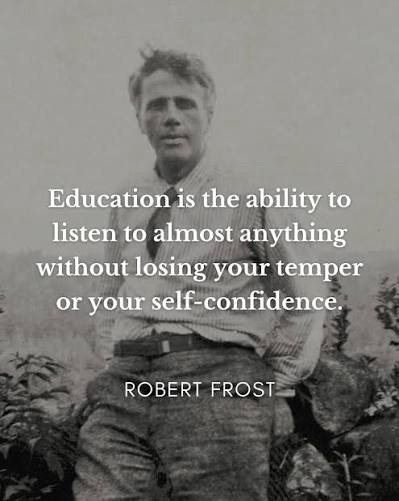
Robert Frost captured this well when he said, “Education is the ability to listen to almost anything without losing your temper or your self-confidence.” Thinking, in this sense, is the ability to hold a position under pressure without emotional leakage. When questioning an idea feels like an attack on the self, confidence is no longer rooted in understanding. This does not mean the other person lacks intelligence or is always choosing blindness. Many people are shaped by conditions that discourage careful examination. Yet there are also moments of real agency, where truth is resisted knowingly. In either case, their resistance does not demand an emotional reaction from us. Judgment is God’s domain, and Scripture is clear that responsibility increases with understanding. Frustration usually enters when we quietly assume that others have a responsibility to truth as we understand it and that by violating that responsibility they forfeit certain intellectual or moral “rights” in the conversation. But this assumption fails to recognize a deeper reality: we do not govern the laws of existence. We do not enforce truth; reality enforces itself. Because of human fallenness, we break reality’s order constantly, often unknowingly, sometimes willfully.
If an idea exists within time, matter, and space, it should be capable of being stated plainly. If it cannot be articulated with clarity. Truth that is understood can survive structure. It can be spoken with the right timing, the right pauses, steady breath, and a calm volume. It has rhythm not just in sound but also in thought. When an idea fights against that rhythm, the body gives it away. Tension shows up. Words rush or tangle. The speaker grows tight or scattered. Many people confuse emotional intensity with meaning, but strong feeling often hides unclear thinking. Precision removes that hiding place. It reveals whether there is a real claim underneath the emotion. Simplicity tests necessity. If words can be removed without weakening the idea, the idea becomes stronger. If it falls apart, then it was never essential to begin with. Resistance does not destroy truth; it sharpens it. Without resistance, you never really know if the shot was aimed true.
This matters because the mind lies to itself by default. We are not our thoughts, and we are not our feelings; we are observers of them. When a person lives as though thoughts or emotions are the self, reality becomes fragile and easily distorted. Frustration does not always mean someone is wrong, but it often points to a weak foundation. More deeply, it can come from the quiet assumption that others owe loyalty to a truth we believe we possess. In reality, no one owns truth. All people stand under the same broken condition, subject to laws none of us designed and none of us escape. Obedience can come before full understanding. Truth does not require complete comprehension before submission. Truth is given by God as a gift; it is not earned by intelligence, effort, or the ability to explain it well. Yet even though truth is given freely by grace, it still works on a person slowly. Wisdom is not instant. God grants truth, and then that truth reshapes the one who receives it. His thoughts will always be much higher than ours. In John 13, Peter objects to Jesus washing his feet. Jesus tells him to allow it, promising understanding later. Peter then overreacts and asks to be washed completely, and Jesus corrects him again. This sequence matters: truth is received first, then it shapes the person. Truth is not earned, but it does sanctify. Belonging is fixed; formation unfolds. Peter does not earn his place with Jesus, and he does not earn the authority he is later given. That authority comes only after failure, denial, and restoration. Only then does Jesus say, “Feed my sheep.” Formation always comes before responsibility. Growth and correction come first; the crown comes later. If this is how God works with us, slowly, patiently, step by step, correcting mistakes along the way, then getting frustrated with others makes little sense. The point is to trust God to shape truth in us, not to trust ourselves to shape God in others. When people resist truth, stumble, or overcorrect, that is not your burden to carry. Your job is not to complete their formation. That belongs to Christ.
𝕯𝕰𝖀𝕾 𝖁𝖀𝕷𝕿 . 𝕹𝖔 𝖌𝖚𝖎𝖑𝖙 𝖎𝖓 𝖑𝖎𝖋𝖊, 𝖓𝖔 𝖋𝖊𝖆𝖗 𝖔𝖋 𝖉𝖊𝖆𝖙𝖍, 𝖙𝖍𝖎𝖘 𝖎𝖘 𝖙𝖍𝖊 𝖕𝖔𝖜𝖊𝖗 𝖔𝖋 𝕮𝖍𝖗𝖎𝖘𝖙 𝖎𝖓 𝖒𝖊 𝖋𝖗𝖔𝖒 𝖑𝖎𝖋𝖊’𝖘 𝖋𝖎𝖗𝖘𝖙 𝖈𝖗𝖞 𝖙𝖔 𝖋𝖎𝖓𝖆𝖑 𝖇𝖗𝖊𝖆𝖙𝖍. 𝕵𝖊𝖘𝖚𝖘 𝖈𝖔𝖒𝖒𝖆𝖓𝖉𝖘 𝖒𝖞 𝖉𝖊𝖘𝖙𝖎𝖓𝖞!!!!
𝕭𝕰𝕹 𝕬𝕹𝕿𝕳𝕺𝕹𝖄 𝕾𝕴𝕸𝕺𝕹
Writing as 𝖂𝕴𝕷𝕷 𝕱𝕺𝕽𝕲𝕰
𝕻𝕴𝕷𝕲𝕽𝕴𝕄 𝕻𝕺𝕹𝕯𝕰𝕽𝕴𝕹𝕲𝕾 𝕸𝕴𝕹𝕴𝕾𝕿𝕽𝖄
 Pilgrims Ponder
10 responses to “Reality’s Enforcer”
Jesus teaches that judgment is reserved for the Lord to exercise. Frost’s timeless reflections breathe with reality in today’s world.
LikeLiked by 1 person
I enjoyed your post! I believe you are right in saying that we are not here to judge and control, but rather to be lights and witness to the darkness around us.
I always say truth does not need a defense. It stands alone and does not need to be embellished or proven. Sometimes it is hard to see the truth for all the commentary around it!
LikeLiked by 1 person
Thank you , Yes, truth doesn’t need our defense, it still has a way of confronting us and exposing where we’re resisting reality. “The word of God is living and active… discerning the thoughts and intentions of the heart” (Hebrews 4:12). Being a peacemaker doesn’t mean avoiding that confrontation, it means responding to it rightly, trusting that God remains sovereign.
LikeLike
Insightful and well expressed. We would do well to take this to heart in these contentious times. Truth can seem all but lost. That can be discouraging, to say the least. But God remains in control.
LikeLiked by 1 person
Amen, thank you Anna
LikeLiked by 1 person
Thank you for these inspirational and encouraging words. I live in the state of Minnesota. I’ve seen the demise of respect for law enforcement here since the George Floyd event. We are struggling here to get the truth in our media but new opinions come out every minute to shape what people think. The division runs very deep and we seem to be growing further apart by the second. The only truth comes from God. We must keep reminding ourselves that he never changes and is in control.
LikeLiked by 4 people
Thank you for sharing this. I completely understand what you mean the events in Minnesota and the way the media portrays them have made it hard to know what to trust. It’s easy to feel like society is fracturing. You’re right: the ultimate truth comes from God, and He never changes. Keeping our eyes on Him, His Word, and His ways is the only sure anchor in such uncertain times.
LikeLiked by 1 person
This is so good and inspiring. Thanks for the share.
LikeLiked by 1 person
Thank you for the support
LikeLiked by 1 person
🤗
LikeLiked by 1 person