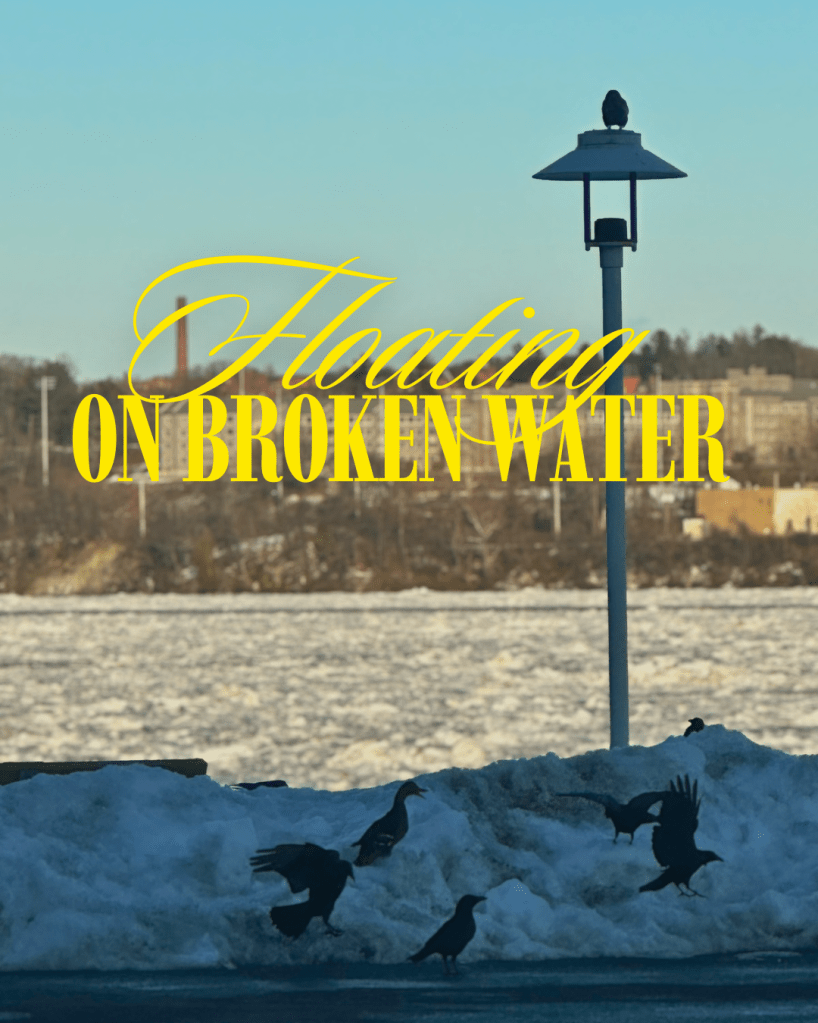
The river is in pieces today. Tons of tiny icebergs that look like dirty shards of dull glass are carried in the current. Some of them hesitate near the edges and gather in the bays, catching for a moment, while the current keeps pulling the rest north. A barge comes through carrying large construction equipment. The pieces begin to separate and slide aside, spreading out toward the banks. Then the bow appears near, wide and blunt, pushing straight downriver toward the city. Behind the barge, open water appears, leaving a clear path for a moment, and then slowly closes again as the current pulls the fragments back into place. It’s a marvel, really, how something so heavy, so massive, can float at all. Boats like this always catch my attention. Ships with this kind of power, pushing ice, carrying hundreds of tons, somehow remain afloat, obedient to the laws of physics and gravity. It’s wild to think that humans have been taking boats like this since just about the beginning of humanity. moving massive things across the water, but never flying. Then suddenly, in the blink of history, we can fly. The Wright brothers were learning to fly, testing tiny, fragile planes. Barely ten years later, airplanes were dropping bombs over Europe in WWI. And yet when we think of the Red Baron, it feels like an entirely different era, like it’s decades removed from those first flights. So much happens so fast, and yet we tell it like it’s far apart. We can build, push, move, and discover. But somehow, we still mess up when we stop acknowledging who we are and who God is. We think movement, power, or ingenuity is ours alone. We forget the rules we didn’t invent. The barge continues downriver, steady, immense. Ice slides aside, and the water flows behind it.
A little ways down, another barge appears. This one is loaded with garbage, Christmas trees, torn boxes, leftover wrappers, pieces of furniture, New Year’s leftovers, and who knows what else. It’s a floating landfill, sliding across the ice. Seagulls swarm it, squawking and landing where they can, picking at what sticks. It pushes forward like the other barge, slow but unstoppable. Dozens of crows suddenly appear right next to me, shouting frantically. They’re dark and sharp, wings flashing as they land and jostle each other. Every scrap within reach becomes a battlefield. They push, pull, fight, and argue over pieces no one wants. They’re clever, no doubt, unafraid of me or each other. They take, they contest, they persist. Intelligence doesn’t make things gentle. Amid the swarm, one duck stands apart, alone on a patch of snow. It’s smaller than the rest, cold and outnumbered, with wings tucked tight against its body. And then it yells, sharp and sudden, back at the crows just enough to keep its ground. Dozens of black wings rush toward it. The duck is chased out, forced along the edge of the ice, alone again, moving with the current.
Across the water, a long walkway spans the river, suspended and steady. Further down, a bridge carries an unbroken stream of cars, headlights, and brake lights flowing without pause. People are crossing in every direction toward work, toward home, toward something they chose, or something they’re resigned to. On the far shore, buildings rise in rows along the water’s edge. Some homes, some shells. The train station sits open, receiving and releasing people at regular intervals. You can imagine the mix of anticipation and regret inside each car, but none of it changes the fact that the doors still close and the train still moves. Behind me, the railroad tracks run tight along the edge of the river. Every thirty minutes or so, a train tears through, making traffic halt for a moment. The crows are smart. You can see it immediately. They calculate distance, risk, and advantage. They remember faces. They know where food appears and when. But standing there watching them, it’s hard to call what they have community. It’s competition. Every movement is contested. Every scrap is fought over. Intelligence without peace. Noise without order. They don’t build anything. They don’t keep anything. They just react faster than the next bird. And if I’m honest, I see myself there more than with the duck. The world tells you to imagine yourself as the innocent underdog, the quiet one pushed out by louder forces. But that’s not usually true. More often, we’re the ones crowding the edge, convinced the scrap in front of us is deserved because we saw it first, grabbed it first, and argued louder. We don’t notice the damage we cause on the way. The duck is cold, outnumbered, and pushed along the ice. That’s how easy it is for humanity to slip downward. Not into evil, but into instinct. Not into monsters, but into machines. Smart. Efficient. Competitive. Loud. Alive, but not human in any meaningful sense. Everything here dies. Ice closes. Water keeps flowing. Nothing wins by force alone. The question isn’t whether you’ll lose. You will. The question is what you become while moving toward that end. Don’t die like a machine. Don’t die like an animal. Die like a man who loved God and was loved by God. And that kind of life doesn’t come from dominance or certainty. It comes from obedience, and obedience often looks like loss.
The river that flows both ways flows north today, whether anyone agrees with it or not. No one votes on it. No one negotiates with it. The current moves by laws older than us. The barges don’t argue with those laws. They submit to them. Men may decide where the barge goes, what it carries, and when it leaves, but none of that explains why it floats. It floats because God made a world where it can. The rules that hold it up do not change, just as God does not change. We like to think movement is ours, power is ours, and ingenuity is ours. But none of it works unless we are held by laws we did not invent. A boat cannot betray the rules that keep it afloat. We can, and we have. We broke what was given. And yet we still float. Not because the laws vanished, but because God Himself made a way to carry us despite our failure. The rules remain. Gravity remains. Judgment remains. One barge carries tools, steel, machinery, and things meant to build. Another carries garbage. God’s order still holds when what we carry is ugly. He remains just, steady, and unmoved. The river keeps flowing. The barges keep moving. Ice breaks, water closes, and paths appear and disappear. Control belongs to God alone. We are carried not by our strength, but by His unchanging design.
Sometimes, in a world of crows, you will be the duck. You will be pushed out. You will not win the space. You will move on alone. That is not failure. Christ already won; we don’t have to. We aren’t living to secure scraps in a shrinking world. We’re living in reality, under laws we didn’t write, for an eternal life with the One who did.
𝕯𝕰𝖀𝕾 𝖁𝖀𝕷𝕿 . 𝕹𝖔 𝖌𝖚𝖎𝖑𝖙 𝖎𝖓 𝖑𝖎𝖋𝖊, 𝖓𝖔 𝖋𝖊𝖆𝖗 𝖔𝖋 𝖉𝖊𝖆𝖙𝖍, 𝖙𝖍𝖎𝖘 𝖎𝖘 𝖙𝖍𝖊 𝖕𝖔𝖜𝖊𝖗 𝖔𝖋 𝕮𝖍𝖗𝖎𝖘𝖙 𝖎𝖓 𝖒𝖊 𝖋𝖗𝖔𝖒 𝖑𝖎𝖋𝖊’𝖘 𝖋𝖎𝖗𝖘𝖙 𝖈𝖗𝖞 𝖙𝖔 𝖋𝖎𝖓𝖆𝖑 𝖇𝖗𝖊𝖆𝖙𝖍. 𝕵𝖊𝖘𝖚𝖘 𝖈𝖔𝖒𝖒𝖆𝖓𝖉𝖘 𝖒𝖞 𝖉𝖊𝖘𝖙𝖎𝖓𝖞!!!!
𝕭𝕰𝕹 𝕬𝕹𝕿𝕳𝕺𝕹𝖄 𝕾𝕴𝕸𝕺𝕹
Writing as 𝖂𝕴𝕷𝕷 𝕱𝕺𝕽𝕲𝕰
𝕻𝕴𝕷𝕲𝕽𝕴𝕄 𝕻𝕺𝕹𝕯𝕰𝕽𝕴𝕹𝕲𝕾 𝕸𝕴𝕹𝕴𝕾𝕿𝕽𝖄
CHECK OUT:
–Floating on broken water – Pilgrims Ponder (Highland, NY)
–The Unlosable Assignment – Pilgrims Ponder (Ulster Park, NY)
–A walk by the Wallkill – Pilgrims Ponder (Wallkill, NY)
–A walk in the woods (shaupeneak ridge) – Pilgrims Ponder (Shaupeneak Ridge, NY)
 Pilgrims Ponder
3 responses to “Floating on broken water”
Thanks, Will. I’ve never thought of myself as a duck in a world of crows. I like the picture. I can continue the picture
LikeLiked by 3 people
I’m glad the image stuck. What struck me while writing was that most of us start as crows and it’s only when we stop playing that game that we find ourselves becoming the duck, whether we want to or not.
LikeLiked by 1 person
I’m embracing my duckness. 😊
LikeLiked by 1 person