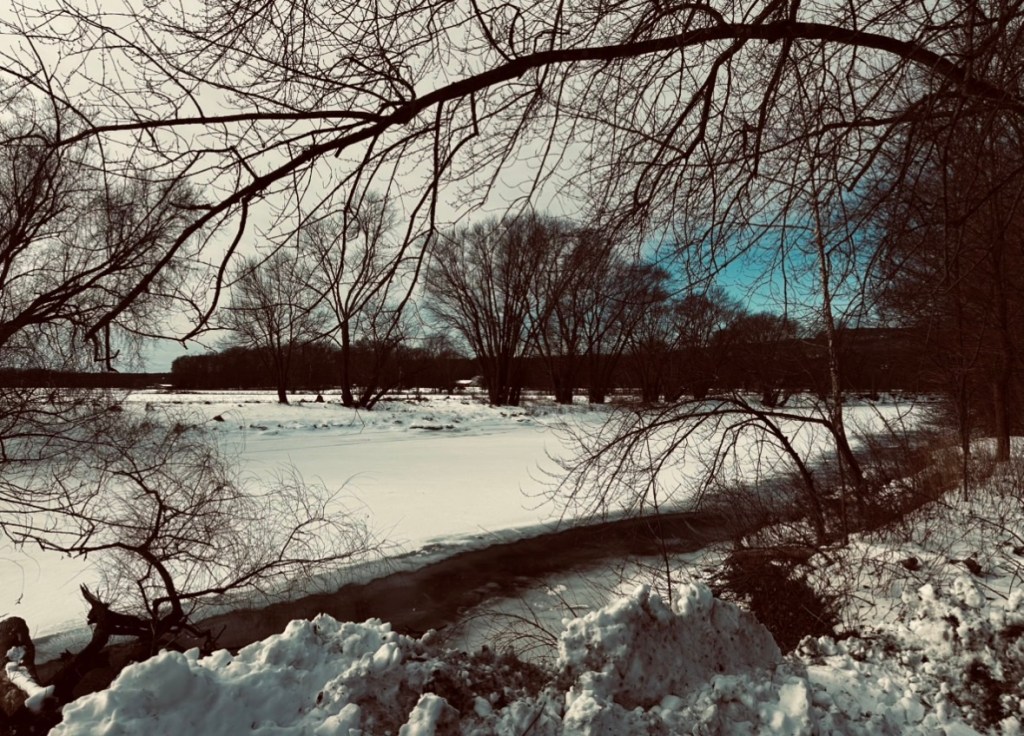
The Wallkill flows north and it flows slowly and crooked but this time of year it does not seem to be flowing at all. This river is old, they say many mastodon bones have been uncovered along its banks. What that means for sure is this river has been here longer than we can officially explain. I don’t know of that but I do know of history I can know. For there is a real contrast between what we can’t fully explain and what we can still meaningfully remember, a quiet lesson between the vast unknown that humbles us and the small, steadfast truths that memory and witness allow us to carry forward.
This land has long been home to native peoples and was later settled by the Huguenots, French Protestants whose faith had been shaped and sharpened by the Reformation. Huguenots fled France due to religious persecution under Catholic monarchy. Their settlement reflects the direct migration consequences of the Reformation, a little over a century after Luther’s theses. Luther didn’t cause European fragmentation; he exposed the existing corruption and human weakness in the Church and monarchy.
In 1678, a group of twelve Huguenot men established the settlement that would become New Paltz, in what is today Ulster County, New York. This group is collectively known as the Duzine, a term derived from the French word douzaine, meaning “dozen.” Louis DuBois, Christian Deyo, Abraham Hasbrouck, André LeFèvre, Jean Hasbrouck, Pierre Deyo, Laurent Bevier, Antoine Crispell, Abraham DuBois, Hugo Freer, Isaac DuBois, and Simon LeFèvre. Before arriving in the Hudson Valley, these families sought temporary refuge in the Palatinate region of Germany. Their stay there influenced the name of their new home: “New Paltz” commemorates the region that offered them shelter and a chance to rebuild their lives in relative safety. Later, in 1710, The Palatines from Germany were also sent to the Hudson Valley. They were employed by English authorities to work in naval camps and other colonial projects.
Louis DuBois is famous for leading the 1663 rescue of his wife, Catherine Blanchan, and their children after they were captured by the Esopus Indians. In Huguenot lore, Catherine was reportedly found singing Psalm 137 (“By the rivers of Babylon…”) while in captivity. The singing of the Psalms lay at the heart of Huguenot worship. Translated into French and set to simple, memorable melodies, these songs were more than liturgy; they were a lifeline. In times of joy, they celebrated the steadfastness of God; in times of persecution and exile, they fortified courage and resolve. It was through this devotion to Scripture set to song that men and women like Louis DuBois were shaped: their faith tested, strengthened, and carried forward even across oceans and into new lands. Louis himself exemplified how faith could sustain action. His courage in rescuing his family, his endurance through displacement, and his role in founding New Paltz were all rooted in the spiritual discipline and comfort that the Psalms provided. In singing them with heartfelt devotion, the Huguenots brought a piece of their homeland across the Atlantic, anchoring both personal and communal identity in a new, unfamiliar world. I am grateful psalms were sung with true hearts in this land.
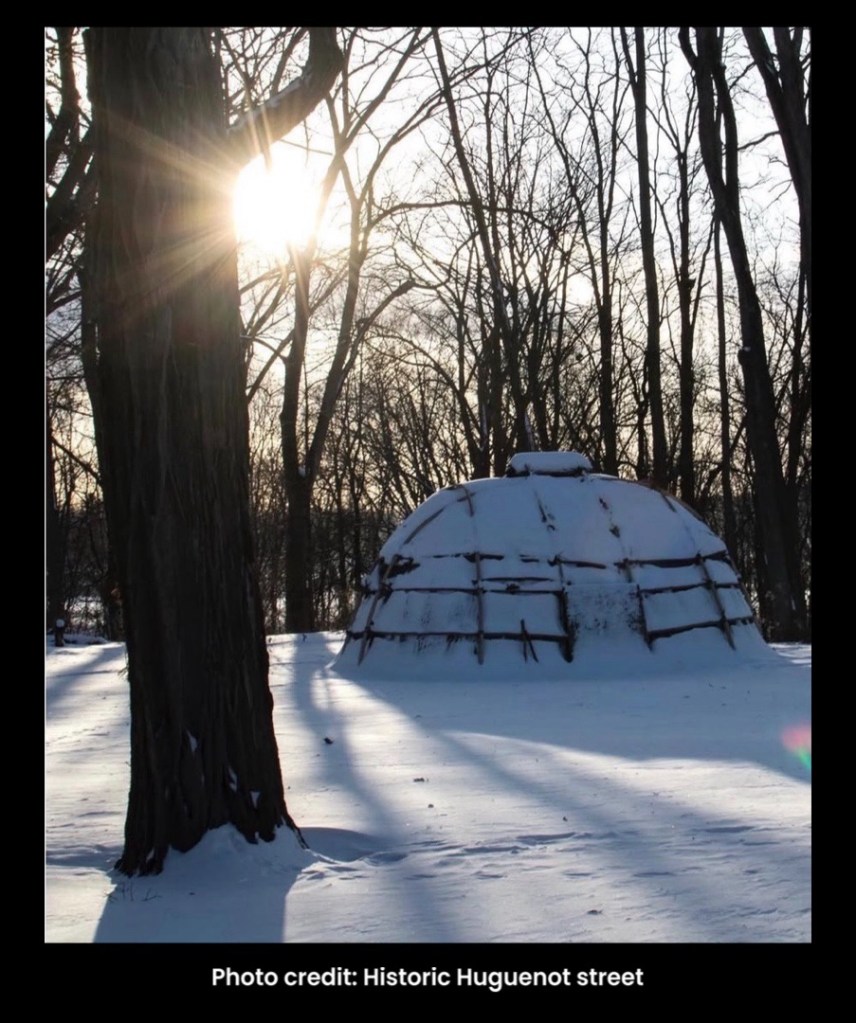
In 1677 the Duzine purchased forty thousand acres from the Esopus Munsee tribe, a transaction later confirmed by English Governor Sir Edmund Andros. By the following year, 1678, they had established the settlement of New Paltz, naming it in honor of their refuge in Mannheim, in the Palatinate region of Germany. The purchase itself was remarkable. Five years before William Penn’s famous treaty in Pennsylvania, the Huguenots negotiated directly with the Esopus sachems, agreeing to pay a relatively high price for the time in goods,tools, cloth, wine, and horses for the land. Even so, the treaty recognized that the Esopus retained certain rights to hunt and fish upon it. In contrast to modern notions of land as a commodity to be fenced and extracted, the New Paltz agreement treated land as a shared stewardship, a space of mutual respect and ongoing relationship. Through decades of conflict the Esopus Wars, the French and Indian War, and even the Revolutionary War New Paltz endured as a haven in a region often marked by raids and turmoil. Today a wigwam sits on the banks of the wallkill on Huguenot St, to me it is a reminder of deliberate choice to live in peace with former adversaries and to cultivate a community rooted in faith, cooperation, and resilience.
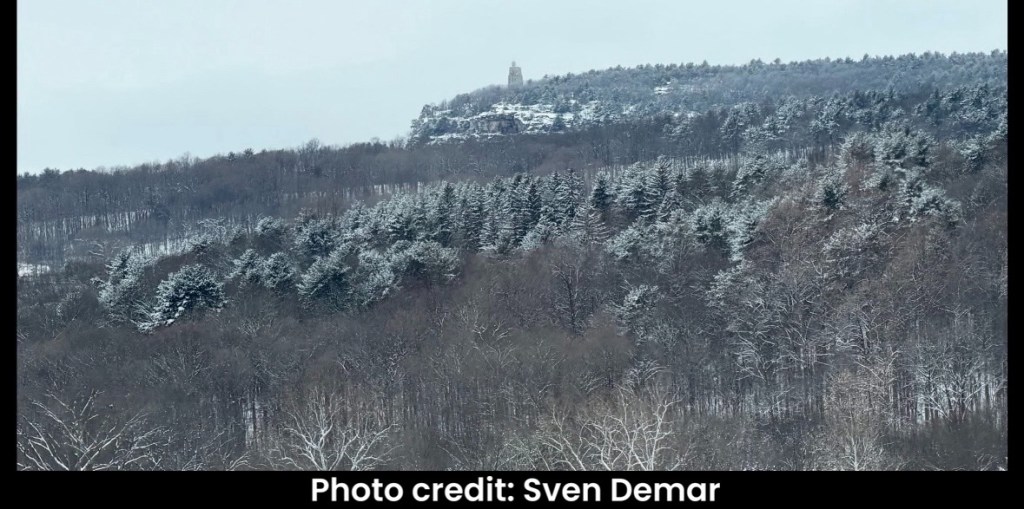
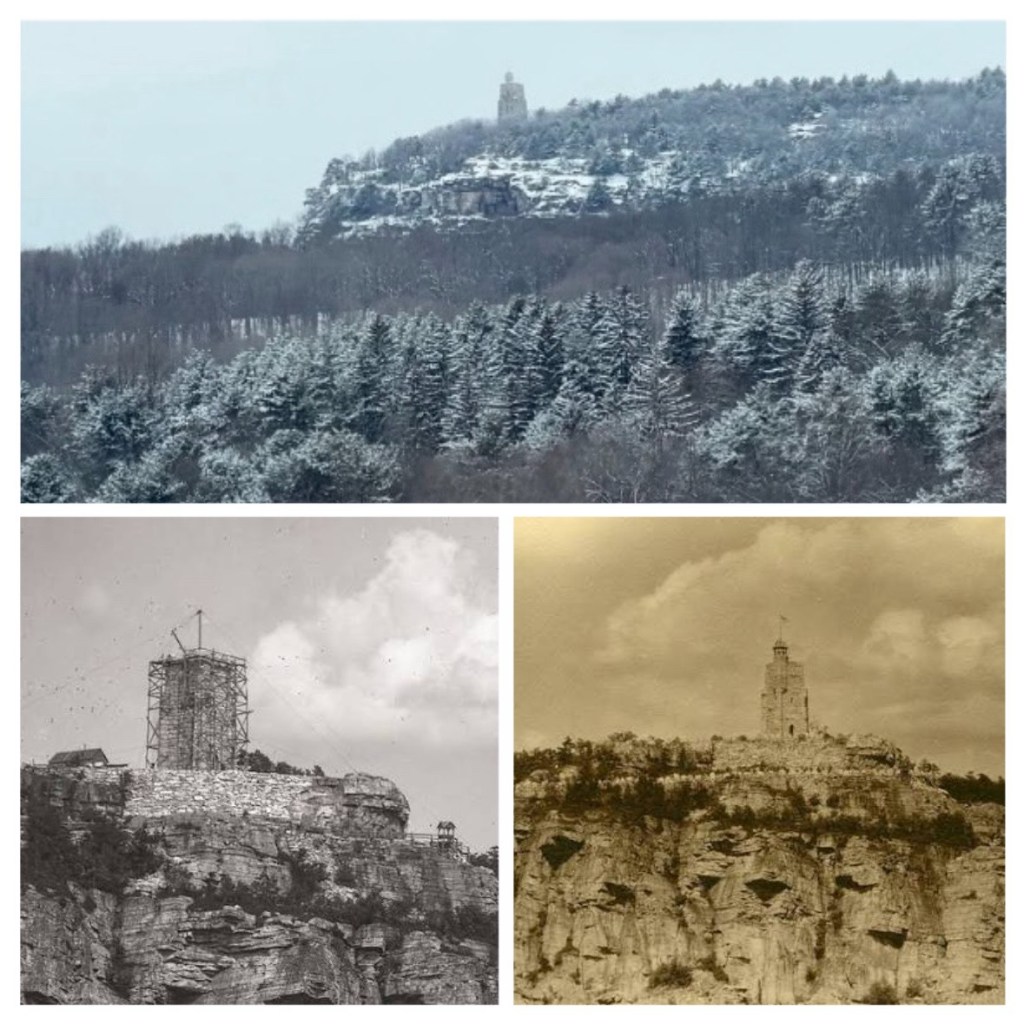
Around this river rise the Shawangunk Mountains. They are not the tallest mountains, but they are mountains with countless stories, so many that a library could scarcely contain them, and so many more that the human mind can imagine. Here grow plants found nowhere else, and here huckleberries and wild creatures flourish. When the sun sets behind the peaks in brilliant orange, it is a reminder that creation speaks in ways that demand more than ears to hear; it calls for attention, patience, and imagination. We are so often content with the smallest satisfactions that we miss the full measure of the stories these hills and valleys hold. There is a rhythm to the land, a timing no human can command. The warmth will return, the flowers will bloom, if we are there to witness it but whether we see it is not ours to decide, just as the return of winter and the birth of our lives were never in our hands but are to be cherished. The ice caves, the ridges, and the endless trails of the mountains require certain abilities, strength, endurance, and attentiveness, that I am grateful to possess, yet not all have them. Yet this does not mean these gifts are only for the few. The fruit of the land, the huckleberries, the lessons of the hills, can be gathered and shared. There is responsibility in this, we do not have rights we have responsibilities that when lived out appear as rights to others, There is goodness and beauty in this all. And yet I look at the Mohonk Skytop Tower, a lighthouse on the mountain. When I see it, I often feel as though I am home. But I know that tower was not there for the Huguenots. That is not an eternal structure. If it were to burn down, if it were to fall, would my home or my peace disappear? Or even greater, if all the vegetation died, if this land became a desert, if the mountains crumbled to dust, would I have Home? Would I have peace? Yes! My peace is not in this wonderful creation. My peace is in the Creator. I am also a creation, a creation so loved that the Lord entered His own creation to be with me. Praise only to the Creator. Thanks be for His creation, and thanks be for His abounding love for it. Even if we are the last generation to know this landscape in a season of relative calm, the last to walk it believing the questions between peoples and histories have been neatly settled. Even if the world shifts beneath our feet and what once felt stable begins to feel uncertain. No matter how mankind changes, no matter how our confidence rises or falls, God remains the same, and His promises do not bend with the age. What He has spoken endures beyond climate, beyond culture, beyond every generation that comes and goes.
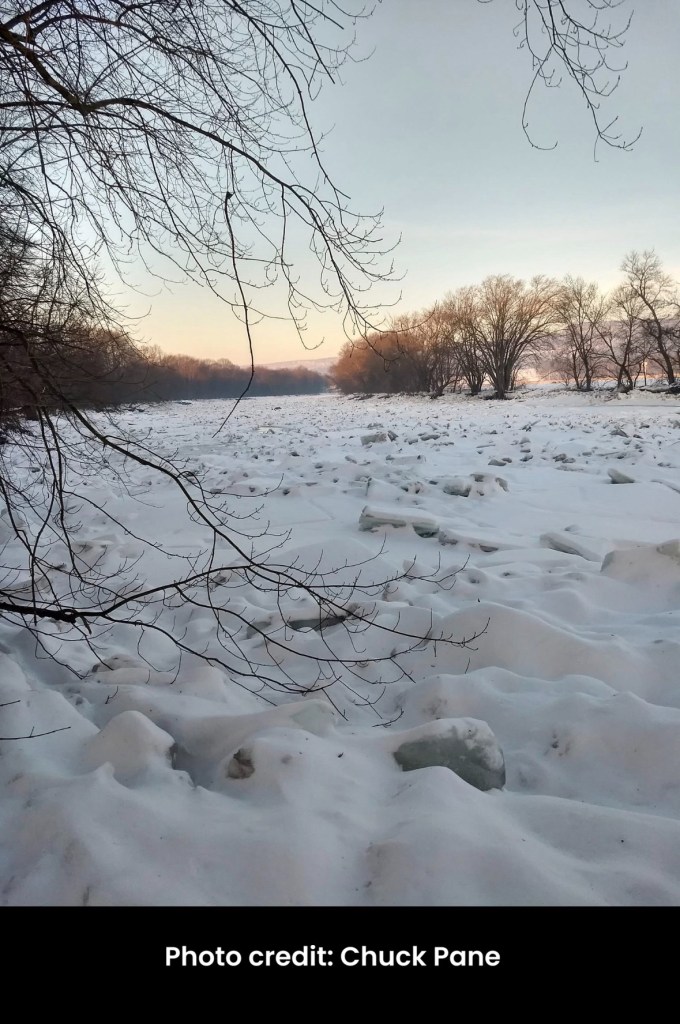
The sunset is quite something over the land, the river is silent, traffic is distant, stories are everywhere, the temperature causes the skin to be in pain. Across the frozen ice, a family of deer moves skittishly, A new year begins in the same land, and the sky darkens as the first stars appear. I pray for everyone in this valley, God be with us all. Do not forget the Creator, for He is good, and His love endures. He truly loves and cares for you, Do not allow learned helplessness or self-centered defense or any evil force of the world to block the reception of His love. I will love this land and steward it where I am placed. But I know, in the end, all will be made new, for all belongs to Him. Mountains may crumble, rivers may freeze, towers may fall, but His Kingdom is eternal. Praise be to the Creator. Thanks be for His creation. Thanks be for His unfailing, abounding love. Forever and ever, Amen.
𝕯𝕰𝖀𝕾 𝖁𝖀𝕷𝕿 . 𝕹𝖔 𝖌𝖚𝖎𝖑𝖙 𝖎𝖓 𝖑𝖎𝖋𝖊, 𝖓𝖔 𝖋𝖊𝖆𝖗 𝖔𝖋 𝖉𝖊𝖆𝖙𝖍, 𝖙𝖍𝖎𝖘 𝖎𝖘 𝖙𝖍𝖊 𝖕𝖔𝖜𝖊𝖗 𝖔𝖋 𝕮𝖍𝖗𝖎𝖘𝖙 𝖎𝖓 𝖒𝖊 𝖋𝖗𝖔𝖒 𝖑𝖎𝖋𝖊’𝖘 𝖋𝖎𝖗𝖘𝖙 𝖈𝖗𝖞 𝖙𝖔 𝖋𝖎𝖓𝖆𝖑 𝖇𝖗𝖊𝖆𝖙𝖍. 𝕵𝖊𝖘𝖚𝖘 𝖈𝖔𝖒𝖒𝖆𝖓𝖉𝖘 𝖒𝖞 𝖉𝖊𝖘𝖙𝖎𝖓𝖞!!!!
𝕭𝕰𝕹 𝕬𝕹𝕿𝕳𝕺𝕹𝖄 𝕾𝕴𝕸𝕺𝕹
Writing as 𝖂𝕴𝕷𝕷 𝕱𝕺𝕽𝕲𝕰
𝕻𝕴𝕷𝕲𝕽𝕴𝕄 𝕻𝕺𝕹𝕯𝕰𝕽𝕴𝕹𝕲𝕾 𝕸𝕴𝕹𝕴𝕾𝕿𝕽𝖄
1/2/2026-1/3/2026
CHECK OUT:
–Floating on broken water – Pilgrims Ponder (Highland, NY)
–The Unlosable Assignment – Pilgrims Ponder (Ulster Park, NY)
–A walk by the Wallkill – Pilgrims Ponder (Wallkill, NY)
–A walk in the woods (shaupeneak ridge) – Pilgrims Ponder (Shaupeneak Ridge, NY)
 Pilgrims Ponder
14 responses to “A walk by the Wallkill”
This is beautiful . . . the writing and the pictures. It makes me very thoughtful; makes me want to know the stories of “my” own Blue Ridge mountains. Praise be to God for His creation!
LikeLiked by 3 people
Thank you so much, I love the Blue Ridge Mountains too their stories are rich and powerful, even more to explore than those of my own Gunks. Abraham Lincoln once said, “I like to see a man proud of the place in which he lives. I like to see a man live so that his place will be proud of him.” And even beyond our love for the lands we call home, my greatest joy is in praising the Creator of such places. His work in these mountains and valleys inspires awe and draws our hearts upward in gratitude.
LikeLiked by 2 people
Amen! That is so encouraging. Happy New Year to you!
Psalm 45
LikeLiked by 2 people
Typo – Psalm 46
LikeLiked by 2 people
What a great post. I lived in upstate NY until I was eight, and my Dad, brother and I would often go hiking in the Spring in the Catskills near the Ashoken reservoir. Interesting about the Huguenots… their faith and their peaceful relations with the native americans. The mountaintop lighthouse is very cool 😎
LikeLiked by 2 people
That’s awesome I’m glad you were able to connect with my post. I am blessed to call this area home. God bless you my friend.
LikeLiked by 1 person
This is fascinating work and testimony. I’m taken with all the details of people and their places and with the quality of faith-expressions. Happy New Year to you!
LikeLiked by 2 people
Thank you, God bless and Happy New Year to you too my friend.
LikeLiked by 2 people
I have not had occasion to visit upstate New York and learn of its history. Thank you for the brief tour! God bless!
LikeLiked by 2 people
If you ever have the chance I highly recommend it, this area is extremely rich in history, it actually was the original intended destination for even the mayflower. God bless my friend, thank you for your time.
LikeLiked by 2 people
Well done! I appreciate this walk into some history that is new to me. The resilience of the human spirit is quite evident.
LikeLiked by 2 people
Thank you. God bless
LikeLiked by 2 people
Thank you for the life lesson on the Huguenot settlement experience and the role that Nature played in their spiritual growth. I’ll keep that lesson in mind for my own soul seeking decisions.
LikeLiked by 2 people
Thank you for reading and for taking the time to reflect on it. I’d only gently clarify that the heart of the piece isn’t really about nature as a tool for personal discernment or self-actualization. The Huguenots weren’t seeking spiritual growth through nature; they were being formed by suffering, exile, memory, Scripture, and land together.
The river isn’t meant as a lesson so much as a witness. Psalm 137 isn’t a wellness psalm, it’s an exile psalm, about remembering who you are when the world tries to make you forget. In that sense, the Wallkill stands in for Babylon’s waters, and the question remains the same: Who are we when we are no longer home? Ultimately, the reflection points beyond creation itself. If the land failed, if the mountains crumbled, if everything familiar disappeared, would peace disappear too? The answer the Huguenots lived by was no. Peace isn’t found in creation, however beautiful, but in the Creator. Creation bears witness to Him, and to His love even more so in times of loss and displacement.
LikeLiked by 1 person