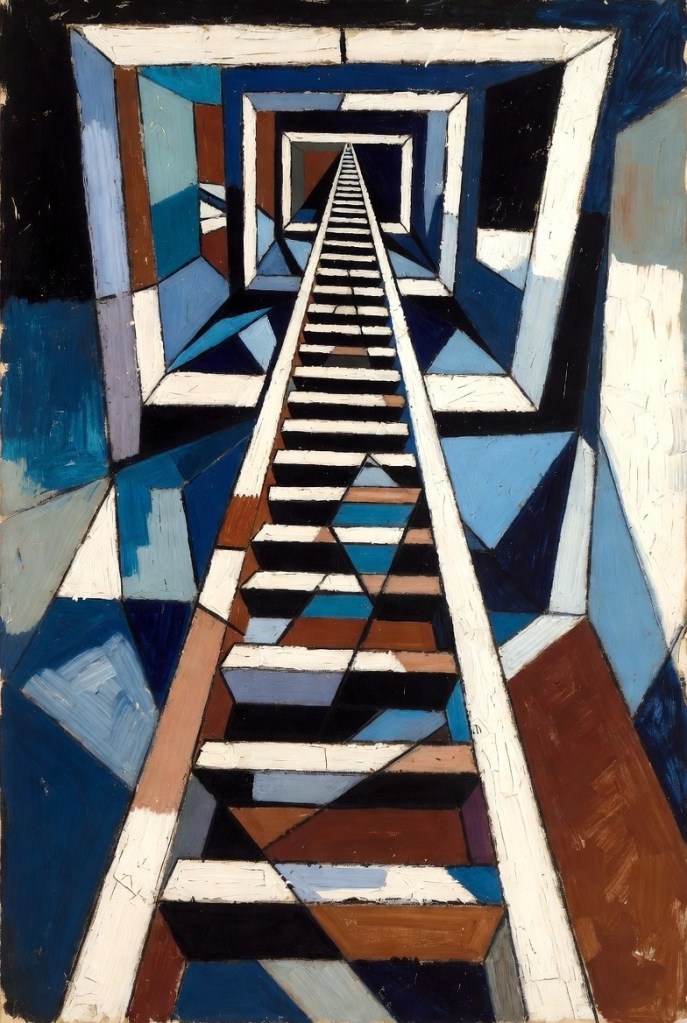
The 70,000 fathom ladder –
A man spent years climbing a huge ladder. People cheered him on, told him it led somewhere important. So he kept going step after step, never looking down. When he finally reached the top, he found nothing there. No platform. No door. No destination. Just empty air. Then he looked down. For the first time he saw how high he’d climbed. His legs shook. His stomach dropped. Slowly climbing back down suddenly felt worse than falling. The fear stretched with every rung. Part of him thought, maybe I should just jump and get rid of the fear.
I’m aware that I am aware of being aware of evaluating how I evaluate how I examine my emotions. This could be the infinite labyrinth or entry to the end. At first, it seems simple: noticing our emotions, recognizing our thoughts, and reflecting on our reactions. “I am angry,” we say. “This makes me uneasy.” Then we notice our noticing: “Why am I angry? Are my thoughts rational?” This is second-order thinking, metacognition. Then comes meta-metacognition: “I observe how I evaluate my thoughts. I see the bias in my self-reflection. I am thinking about how I think about thinking.” 4th-order thoughts are simply thoughts about your 3rd-order thoughts. “I’m aware that I’m examining the way I examine my emotions.” 5th order is awareness of your 4th-order thought. “I realize that I am aware of examining how I examine the way I examine my emotions.” 6th order is awareness of your 5th and so on. This recursive process does not make us godlike. It is useless at a point. It only creates the illusion of infinite depth.
God does not climb a ladder of thought. His knowledge is immediate, whole, and complete: He knows all things without division, without sequence, and without reflection. To imagine God this way is to impose human limitation onto the infinite. And yet, as humans continue climbing the ladder of awareness, there comes a ceiling. The mind cannot reflect further; recursion breaks; self-awareness reaches its limits. At that point, the only remaining category is a being whose knowledge requires no recursion, a perfect, unsearchable, knowing the end from the beginning, whose thoughts are not our thoughts. You don’t need to think about thinking about thinking. God does not hide behind philosophical ladders. His revelation comes downward, not upward. He speaks in Scripture; we receive by faith. Relationship requires trust, not abstraction. If you had to maintain the universe in your mind, you would break. God’s perfect knowledge means He holds every detail, every future, every motive, every hidden sorrow and without strain. You do not need to “figure everything out.” You can rest because He is not learning as He goes. Human consciousness is not equipped to bear infinite recursion. If a person tried to sustain endless self-analysis, thinking about thinking about thinking, tracing every motive, every fear, every possibility, they would break under the weight. The mind would spiral into confusion, distortion, and disintegration. Historically, theologians and philosophers have warned that the attempt to hold God-sized burdens inside a human-sized mind is a path into mental chaos. Not because reflection is evil, but because the human mind was never engineered to be its own final reference point. If human thought had no limits, no edges, and no stopping point, we would not become gods; we would lose ourselves. Endless introspection without a boundary produces paranoia, fear, a collapsing sense of identity, and the inability to distinguish internal imagination from external reality.
Our limits are not punishments; they are mercies. God limits our lifespan so we cannot destroy creation endlessly. God limits our strength so we cannot dominate everything. God limits our understanding, so we must look beyond ourselves. God is good because He keeps us human. The ladder is not meant to be climbed infinitely. It is a tool for moral clarity, not an infinite staircase to self-deification. Eventually the rungs end, not to trap us, but to redirect us. The 70,000-fathom depth is not about uncertainty of God’s existence. It’s about the vulnerability and surrender required to follow Him even after you know He’s real.
Humanity must examine, test, and renew itself. Higher-order thinking exists because we are limited, because thought is a frontier. Physical boundaries recede, and the mind becomes the new wilderness. Theology is no different. Doctrine is fixed, yet the frameworks explaining it evolve. The Trinity was always true, but the words used to describe it were invented centuries later. Augustine framed time, Aquinas synthesized Aristotle, Luther reframed justification, and Pascal applied probability theory to belief in God. The truth remains, but our understanding of it develops. The frontiers of thought, philosophical, psychological, and conceptual, are what remain when the physical world yields no new horizons.
Innovation, then, is not heresy. Contradicting Scripture is heresy. Reframing it for a new era is faithfulness. Pascal’s Wager, for instance, operates on a transactional plane: bet on God, and if you’re right, infinite gain; if wrong, no loss. Modern Christian work, however, must shift the battlefield. Faith is not only about outcomes. The challenge today is semantic: reclaiming meaning from a culture that borrows our language while emptying it of its weight. Words like “love,” “truth,” and “justice” carry altered significance in a relativistic world. If someone hears “love” as sentimentality rather than covenantal sacrifice, the argument about God’s reality fails before it even begins.
This is semantic mimicry, the very deception Scripture warns against. Satan’s strategy has always been to twist words subtly: “Did God really say…?” Genesis 3:1. False apostles masquerade as servants of righteousness. Jesus condemned traditions that nullified God’s word by changing its meaning. Language is the battlefield, and the modern Christian task is to expose the mimicry. To name it is not to invent it, but to map it, make it navigable, and use it strategically.
This recursive, meta-cognitive work is rare, exhausting, and frustrating. Most people stop at first-order thought, rewarded by survival, comfort, and cultural approval. Few climb higher because self-awareness reveals our inconsistencies, biases, and limits. Most desire goodness and significance without understanding their own terms for either. Deep ideas never spread without incarnation. They must be translated into stories, movements, curricula, practical programs, or identities. Pascal’s ideas were systematized by later apologists. Augustine’s by Aquinas. Kierkegaard’s by existentialists. Jesus’ teachings by Paul. Lewis’ theology by children’s fiction. Depth alone sits on a shelf; incarnation is required for reach. If you understand the deeper structure, translate it simply. If God has given you the ability to climb the ladder of thought to see the philosophical structure beneath people’s assumptions, then your job is not to show off the complexity. It is to translate it. It is not to dumb down but to communicate properly. If you do not understand the deeper structure, don’t be anxious. You were never meant to carry that weight. You are not saved by how far up the ladder of self-reflection you can climb. You are saved because God came down the ladder to meet you. And if you do understand, you don’t need to be frustrated with those who don’t. Because it is not necessary for them. God does not distribute mental tools equally. He distributes grace equally. Understanding is a gift meant for service, not superiority. If you climb higher, you do so only to help others see more clearly. If others do not climb, it is no deficit; they are not meant to. And there is no need for frustration because God designed His truth to be accessible even to the simplest mind.
Recursion has no bottom. The hole is endless. Yet the only solid ground was never in the hole. It was above all along. God’s love does not require Level 10,000 of awareness. A child, a person with dementia, or someone who has never consciously reflected is fully loved. Jesus died not for those who climbed to the top of the ladder, but for those at the bottom who looked up and called, “Rescue me.”
The ladder is a tool, not the destination. It clarifies, exposes, and rebuilds pathways for others to see. But when it collapses, as it inevitably does, look up. The solid ground has always been there. The recursive mind reaches exhaustion; God reaches eternity. The moment we stop trying to perfect awareness for its own sake, we rest in the One who does not require mirrors to know the truth. And in that rest, all we have seen on the way up becomes a resource for helping others reach the same arms, without forcing them to climb what we could never finish.
The work of deep thought, semantic clarity, and theological reflection is not self-fulfillment; it is service. Joseph did not need prophetic insight for his own sake; Egypt did. Daniel did not need heavenly wisdom; Babylon did. Paul did not need theological genius; the early Church did. Depth is not for pride; recursion is not for glory. It is a responsibility: to name, map, and clear paths so others can see Christ, to expose semantic mimicry, and to offer guidance where the culture has blurred meaning.
Rest is found not in the ladder, not in the mirrors, not in the recursive climb, but in the arms of the One who requires no levels at all. And there, only there, is true understanding, true peace, and true mission.
I often end up doing the very thing I warn others not to do. I can overthink, over-explain, and then congratulate myself for “seeing through” the overthinking. It’s a strange trick pride plays on the mind. I climb the ladder, then boast that I was clever enough to climb back down. I analyze my own analysis and call it humility. this position is very comfortable for someone who likes thinking. It lets me enjoy the intellectual work while claiming innocence for it.
This website was meant to be a living journal, a place for honest reflections. Yet somewhere along the way I turned it into a workshop: ideas sanded down, stained, varnished, and displayed as “wisdom.” But let’s be honest most of this isn’t universal insight. It’s my personal mental clutter rearranged neatly so I can pretend it belongs on a bookshelf. When exhaustion masquerades as revelation. When the very limits of my thinking become a kind of sales pitch for others. It’s gross and I apologize. In conclusion a simpler, truer statement would be that endless self-analysis wears me down, and faith gives me rest not because I rose above my mind, but because I finally stopped running in circles. Just fatigue and the mercy of God.
If thinking so deeply is so treacherous, why model it for thousands of words? If faith doesn’t require a ladder, why describe mine in such detail you could rebuild it from memory? Why do I wrap it in such elaborate theological packaging that the packaging becomes heavier than the gift? It’s like warning someone about drowning, then handing them a beautifully carved anchor. Sometimes I think the greatest spiritual discipline for me would simply be silence. Spiritual victories often go unnoticed, even by the one who just won them. We expect fireworks; God gives us quiet turning points. We want a trophy; God hands us obedience. People say “rest and recharge,” as if spiritual life is a vacation brochure. But real “R&R” isn’t rest from mission it’s rest for mission. Victories don’t end the work; they fuel it. your spiritual resume isn’t measured in catchphrases, but in scars, obedience, and a heart that still says, “Yes, Lord,” after a long day. And that yes is worth it. We underestimate God constantly. We behave like He can save our souls but not handle our Tuesday. But God is never outmatched by our circumstances. If anything, we’re the ones dreaming too small, asking for coins when He intends to rebuild our legs.
Scripture is full of people who came to God expecting crumbs and walked away with a feast. Look at the lame beggar in Acts 3. The man isn’t dreaming big he wants coins. Spare change. Two dollars for lunch. That’s all he’s hoping for. Peter doesn’t give him money. He makes the Man walk for the first time in his life.
God delivers the highest possible good. And yet even that miracle is temporary. The man who danced that day eventually died. The legs that were healed eventually weakened. Physical healing is beautiful, but spiritual resurrection is eternal. That’s the point. So don’t obsess over the past, and don’t anxiously idolize the future. And for the love of God, don’t focus on “the focus,” as if staring at your own thought process will produce holiness. Fix your eyes on Christ’s victory which is a present reality, not a theoretical ladder you hope to climb someday.
He is risen indeed. Not “was,” not “will be,” but IS. Right now. In the moment you open your eyes in the morning. In the moment you face the day you don’t want to face. In the moment you wash dishes, do homework, or sweep dirt off a floor. He is Lord of the dirty dishes. Lord of the dirt. Lord of the callous on your hands. Our Lord swung a hammer before He spoke a sermon.
And if you ever feel yourself climbing gaining momentum, feeling proud of your own spiritual muscles step off the ladder immediately. Any ascent worth anything is His doing, not yours and especially not mine. Our task is simple: wake up, remember Christ’s victory, and walk in it.
In Christ alone.
(Investing in the Church of the Body of Christ is highly important. Community is a training ground and a support system. Loving, serving, and learning within the Church equips you to navigate life’s difficulties with guidance, accountability, and shared wisdom. Spiritual formation through prayer, Scripture, and fellowship is the groundwork for resilience. These practices are not indulgences; they are essential preparation for the realities of living in a world marked by moral, physical, and emotional challenges. Find a local Biblical church today! – ( church map= https://www.google.com/maps/d/u/0/viewer?ll=40.52106123277431%2C-41.39371617622709&z=2&mid=1SRpkwF4hEaXZvor4BXyoAawrNVgH9CM )
𝕯𝕰𝖀𝕾 𝖁𝖀𝕷𝕿 . 𝕹𝖔 𝖌𝖚𝖎𝖑𝖙 𝖎𝖓 𝖑𝖎𝖋𝖊, 𝖓𝖔 𝖋𝖊𝖆𝖗 𝖔𝖋 𝖉𝖊𝖆𝖙𝖍, 𝖙𝖍𝖎𝖘 𝖎𝖘 𝖙𝖍𝖊 𝖕𝖔𝖜𝖊𝖗 𝖎𝖓 𝕮𝖍𝖗𝖎𝖘𝖙 𝖎𝖓 𝖒𝖊 𝖋𝖗𝖔𝖒 𝖑𝖎𝖋𝖊’𝖘 𝖋𝖎𝖗𝖘𝖙 𝖈𝖗𝖞 𝖙𝖔 𝖋𝖎𝖓𝖆𝖑 𝖇𝖗𝖊𝖆𝖙𝖍. 𝕵𝖊𝖘𝖚𝖘 𝖈𝖔𝖒𝖒𝖆𝖓𝖉𝖘 𝖒𝖞 𝖉𝖊𝖘𝖙𝖎𝖓𝖞!!!!
𝕭𝕰𝕹 𝕬𝕹𝕿𝕳𝕺𝕹𝖄 𝕾𝕴𝕸𝕺𝕹
Writing as 𝖂𝕴𝕷𝕷 𝕱𝕺𝕽𝕲𝕰
𝕻𝕴𝕷𝕲𝕽𝕴𝕄 𝕻𝕺𝕹𝕯𝕰𝕽𝕴𝕹𝕲𝕾 𝕸𝕴𝕹𝕴𝕾𝕿𝕽𝖄
Banks of Hudson River
November 20-25, 2025
.
 Pilgrims Ponder