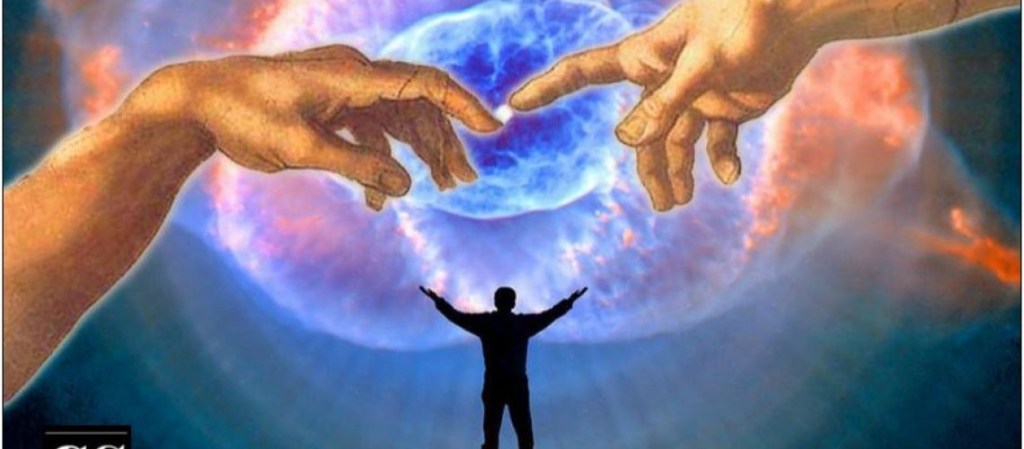
2 Corinthians 4:18—”So we do not focus on what is seen, but on what is unseen. For what is seen is temporary, but what is unseen is eternal.”
Everything in this world operates within certain limits. Your sneakers wear out. Your car needs repairs. Even your neighborhood changes over time. We, too, are born, we grow, and we eventually die. We are in a materialistic body and we use materialistic instruments. The immaterial is not something we can fully grasp because we’re limited by the stuff we experience every day. But just because we can’t fully understand infinity with our finite minds doesn’t mean it’s not real. This is reality, the ultimate reality. The God I worship exists beyond those limits. He isn’t bound by time or decay. That truth is challenging to grasp; He can’t be fully measured, touched, or understood through the world we experience. And that makes sense. Our finite minds can’t contain infinity, yet I’m grateful for it. I’m thankful that He is beyond all this, even if it doesn’t fully make sense, and yet He chose to reveal himself.
We might not be able to understand eternity completely, but we can know that there’s a power behind it all, a power beyond what we see and feel. If our thoughts were merely random brain sparks, then why does a human life have more value than a rock? Why do we grieve at funerals? Why do we honor acts of selflessness, like when someone steps up to protect a loved one, even at the cost of their own life? There’s something in us that sees beyond the physical world. When a person chooses to break free from the cycle of violence or hardship, when someone rises above the circumstances to become more, that’s not just biology in action. That’s a choice. That’s spirit and soul. Science can track the brain’s chemical reactions, but can it measure the exact depth of love a mother feels for her child? Can it explain why a person would risk everything for the sake of their enemy? It can’t. Science can measure emotions, but it can’t measure the essence of those emotions.
There is an old parable where science is like analyzing a cake. A chemist can break it down, measure the flour, sugar, eggs, and baking powder, and even explain exactly how it rose in the oven. But the chemist can’t tell you who baked it or why she baked it, whether it was for a celebration, to cheer someone up, or just because she loved to bake. Science explains the how, not the why. The same is true in life. Science can dissect the universe, explain disease, trace genetic patterns, or calculate probabilities. It can even describe suffering in terms of biology or chemistry. But science alone cannot tell us what suffering means, why evil exists, or what hope looks like in the midst of it. The cross, on the other hand, shows us God’s heart that even when the world fractures, He is present, loving, and active in redeeming it. There is no conflict between science and faith. God is the Creator of all things, including the laws and patterns that science uncovers. He exists outside of time and matter, and science only describes the universe from within it. The problem comes when modern thought neglects the “right brain” of meaning when we focus solely on knowing how things work but ignore why they matter. Science dissects; religion assembles for purpose. Science tells us mechanisms, but meaning and value come from something beyond mere observation. As Albert Einstein wisely noted, “You are right in speaking of the moral foundations of science, but you cannot turn around and speak of the scientific foundations of morality.” Rationality is not coextensive with science. Newton’s law of gravity describes motion but doesn’t explain gravity itself. Every scientific explanation is incomplete because it rarely accounts for the full picture. Faith doesn’t oppose science; it completes it. Science can tell us the ingredients and the mechanics, but only God can tell us the meaning behind it all. Only He gives the why, the heart, the reason to hope, and the reason to live well in a world that science alone cannot fully explain. underlying causes.
The human experience is marked by longing, loss, love, guilt, purpose, and transcendence realities that don’t show up in a blood test or a brain scan, yet shape us profoundly. We are more than chemical machines. We are moral, spiritual beings, made in the image of a personal, loving God. When mental and emotional struggles are treated solely as biological malfunctions, we stop asking the bigger questions: What am I living for? What does my suffering mean? Do I need to forgive someone? Am I harboring shame or guilt that needs to be brought into the light? These are not chemical issues; they are human ones. The soul needs shepherding, not just sedation. When we are taught that our struggles are simply a matter of faulty brain chemistry, we may begin to believe we’re powerless. We become dependent on prescriptions, systems, and labels and less likely to pursue spiritual healing. We become consumers of treatment rather than seekers of truth. If our first response is to treat the brain instead of tending to the heart, we risk missing the invitation that suffering can bring: to turn toward God, to find comfort in His love, and to walk the long, hard, beautiful road toward real transformation.
When a person says that science, or politics, or systems are the only paths to truth or reform, they radically diminish what it means to be human. You cannot abolish God and still retain a true value for human beings. History has proven this again and again: to remove God from the center is to remove the source of human dignity itself. If man is not made in the image of God, then he is merely a byproduct of chance, a fleeting spark in a blind and indifferent process. Without divine purpose, human life becomes nothing more than a brief interruption in an endless lottery of existence. We are told this is “freedom,” but what kind of freedom is it to live without meaning, without ultimate hope, only to be crushed by the same forces that produced us? Some freedom, that is. Yet there is infinitely more to the greatness of God. He is not only Creator and Judge, but He is also Grace, and He is Love. Every true accomplishment, every act of power, and every movement of life itself is done by Him and through Him. And in the supreme act of His love, God Himself became human. The Word became flesh. Christ did not simply bring a new philosophy or moral code; He was the truth incarnate. His miracles, His healings, and His teachings all testified to His authority, but they were not the heart of His mission. His purpose was to bridge the moral chasm that separates humanity from its Creator. On the cross, He took upon Himself the full weight of divine wrath. And the greatest proof of His truth, love, and power is the resurrection. In that moment, death itself was conquered. The tomb was empty not merely as a symbol, but as a testimony to the living power of God. Every spark of energy, every transformation in creation, and every hope that springs up in the human heart all point back to Him. All is by the power of God.
(Investing in the Church of the Body of Christ is highly important. Community is a training ground and a support system. Loving, serving, and learning within the Church equips you to navigate life’s difficulties with guidance, accountability, and shared wisdom. Spiritual formation through prayer, Scripture, and fellowship is the groundwork for resilience. These practices are not indulgences; they are essential preparation for the realities of living in a world marked by moral, physical, and emotional challenges. Find a local Biblical church today! – ( church map= https://www.google.com/maps/d/u/0/viewer?ll=40.52106123277431%2C-41.39371617622709&z=2&mid=1SRpkwF4hEaXZvor4BXyoAawrNVgH9CM )
Lennox, John, and Christopher Hitchens. Is God Great? Debate. YouTube, 11 Mar. 2009,www.youtube.com/watch?v=5OXPlUCGScY.
𝕯𝕰𝖀𝕾 𝖁𝖀𝕷𝕿 . 𝕹𝖔 𝖌𝖚𝖎𝖑𝖙 𝖎𝖓 𝖑𝖎𝖋𝖊, 𝖓𝖔 𝖋𝖊𝖆𝖗 𝖔𝖋 𝖉𝖊𝖆𝖙𝖍, 𝖙𝖍𝖎𝖘 𝖎𝖘 𝖙𝖍𝖊 𝖕𝖔𝖜𝖊𝖗 𝖎𝖓 𝕮𝖍𝖗𝖎𝖘𝖙 𝖎𝖓 𝖒𝖊 𝖋𝖗𝖔𝖒 𝖑𝖎𝖋𝖊’𝖘 𝖋𝖎𝖗𝖘𝖙 𝖈𝖗𝖞 𝖙𝖔 𝖋𝖎𝖓𝖆𝖑 𝖇𝖗𝖊𝖆𝖙𝖍. 𝕵𝖊𝖘𝖚𝖘 𝖈𝖔𝖒𝖒𝖆𝖓𝖉𝖘 𝖒𝖞 𝖉𝖊𝖘𝖙𝖎𝖓𝖞!!!!
𝕭𝕰𝕹 𝕬𝕹𝕿𝕳𝕺𝕹𝖄 𝕾𝕴𝕸𝕺𝕹
Writing as 𝖂𝕴𝕷𝕷 𝕱𝕺𝕽𝕲𝕰
𝕻𝕴𝕷𝕲𝕽𝕴𝕄 𝕻𝕺𝕹𝕯𝕰𝕽𝕴𝕹𝕲𝕾 𝕸𝕴𝕹𝕴𝕾𝕿𝕽𝖄
 Pilgrims Ponder